The following substitution reaction, between a strong base and a 1° haloalkane, occurs in a single step via backside displacement. Yet it is not technically an SN2 reaction. Why?
Verified step by step guidance
1
Understand the mechanism of an Sₙ2 reaction: It is a bimolecular nucleophilic substitution reaction where the nucleophile attacks the electrophilic carbon from the opposite side of the leaving group, resulting in a single-step backside displacement.
Analyze the given reaction: The problem states that the reaction involves a strong base and a 1° haloalkane, and occurs via backside displacement in a single step. This description aligns with the general features of an Sₙ2 reaction.
Consider the role of the strong base: Strong bases can sometimes act as nucleophiles, but their primary function is to abstract protons. If the strong base is involved in proton abstraction rather than direct nucleophilic attack, the reaction mechanism may differ from a true Sₙ2 process.
Explore alternative mechanisms: The reaction might be classified as an E2 elimination rather than an Sₙ2 substitution. In an E2 mechanism, the strong base abstracts a proton from the β-carbon, leading to the formation of a double bond, while the leaving group departs simultaneously in a single step.
Conclude why it is not technically an Sₙ2 reaction: If the strong base is primarily involved in elimination rather than substitution, the reaction mechanism is better described as E2 rather than Sₙ2, despite the single-step nature and backside displacement.
Verified video answer for a similar problem:
This video solution was recommended by our tutors as helpful for the problem above
Play a video:
0 Comments
Key Concepts
Here are the essential concepts you must grasp in order to answer the question correctly.
Substitution Reactions
Substitution reactions involve the replacement of one functional group in a molecule with another. In organic chemistry, these reactions can be classified into two main types: Sₙ1 and Sₙ2. Sₙ2 reactions are characterized by a single concerted step where the nucleophile attacks the electrophile from the opposite side of the leaving group, leading to inversion of configuration.
Backside attack refers to the mechanism by which a nucleophile approaches the electrophilic carbon atom from the side opposite to the leaving group. This approach is crucial for Sₙ2 reactions, as it allows for the simultaneous bond formation and bond breaking, resulting in inversion of stereochemistry. However, in certain cases, such as with strong bases and 1° haloalkanes, the reaction may proceed differently, affecting the classification.
Strong bases can facilitate elimination reactions in addition to substitution reactions. When a strong base reacts with a 1° haloalkane, it may lead to an E2 elimination pathway instead of an Sₙ2 substitution. This duality in reactivity can complicate the classification of the reaction, as the presence of a strong base can favor elimination over substitution, even if a backside attack occurs.


 Verified step by step guidance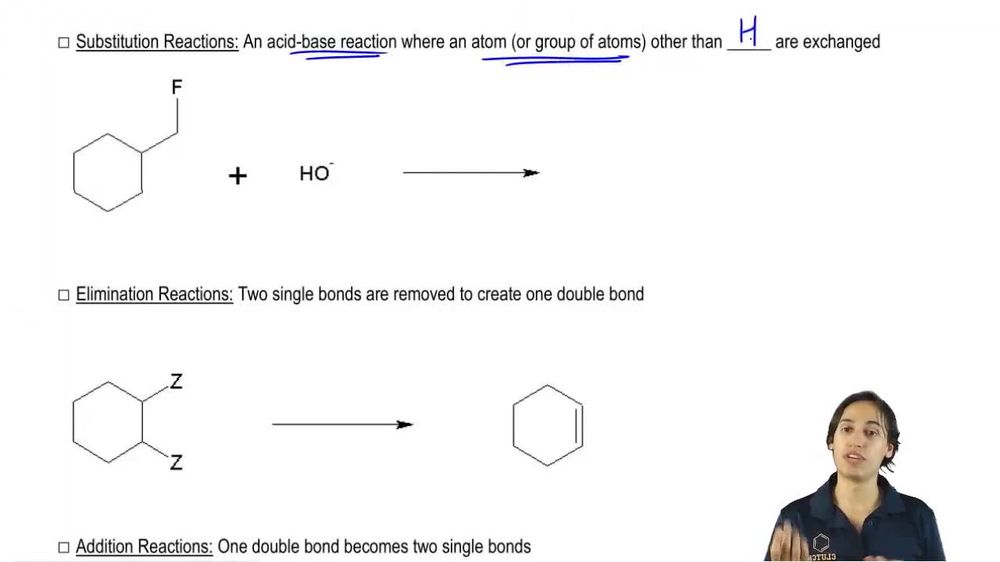
 01:34
01:34