Explain how the following changes affect the rate of the reaction of 2-bromo-2-methylbutane with methanol: a. The alkyl halide is changed to 2-chloro-2-methylbutane. b. The alkyl halide is changed to 2-chloro-3-methylbutane.
Verified step by step guidance
1
The reaction of 2-bromo-2-methylbutane with methanol proceeds via an SN1 mechanism. In an SN1 reaction, the rate-determining step is the formation of the carbocation intermediate. The stability of the carbocation and the leaving group are key factors influencing the reaction rate.
a. When the alkyl halide is changed to 2-chloro-2-methylbutane, the leaving group changes from bromide (Br⁻) to chloride (Cl⁻). Bromide is a better leaving group than chloride because it is larger and more polarizable, making it more stable as an anion. Therefore, the rate of the reaction will decrease because chloride is a less effective leaving group, slowing down the rate-determining step.
b. When the alkyl halide is changed to 2-chloro-3-methylbutane, the structure of the alkyl halide changes, and the carbocation formed during the reaction will be different. In this case, the carbocation formed would be a secondary carbocation instead of a tertiary carbocation. Tertiary carbocations are more stable than secondary carbocations due to greater hyperconjugation and inductive effects. As a result, the rate of the reaction will decrease because the secondary carbocation is less stable, making the formation of the carbocation slower.
In summary, both changes (a and b) result in a decrease in the reaction rate, but for different reasons: (a) due to a less effective leaving group and (b) due to a less stable carbocation intermediate.
To analyze such problems systematically, always consider the two main factors in SN1 reactions: the quality of the leaving group and the stability of the carbocation intermediate.
Verified video answer for a similar problem:
This video solution was recommended by our tutors as helpful for the problem above
Video duration:
5m
Play a video:
0 Comments
Key Concepts
Here are the essential concepts you must grasp in order to answer the question correctly.
Nucleophilic Substitution Mechanism
Nucleophilic substitution is a fundamental reaction in organic chemistry where a nucleophile replaces a leaving group in a molecule. The rate of this reaction can depend on the structure of the alkyl halide and the nature of the nucleophile. In this case, the reaction of 2-bromo-2-methylbutane with methanol involves a nucleophilic attack by methanol on the carbon atom bonded to the bromine, leading to the formation of an ether.
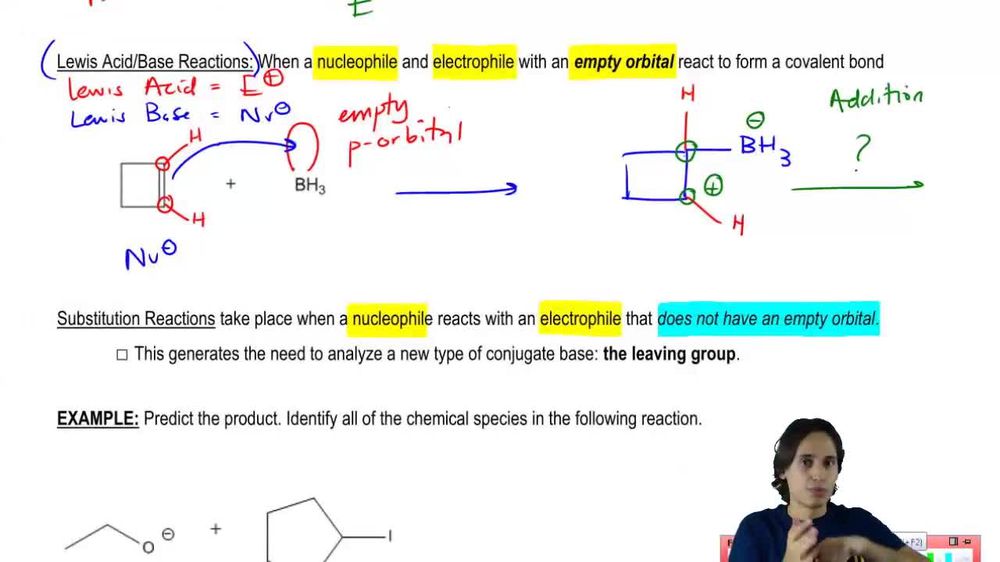
Nucleophiles and Electrophiles can react in Substitution Reactions.
Leaving Group Ability
The ability of a leaving group to depart from a molecule significantly influences the rate of nucleophilic substitution reactions. Bromine is generally a better leaving group than chlorine due to its larger size and weaker bond strength with carbon. Therefore, changing from 2-bromo-2-methylbutane to 2-chloro-2-methylbutane would likely slow the reaction rate because chlorine is a less effective leaving group.
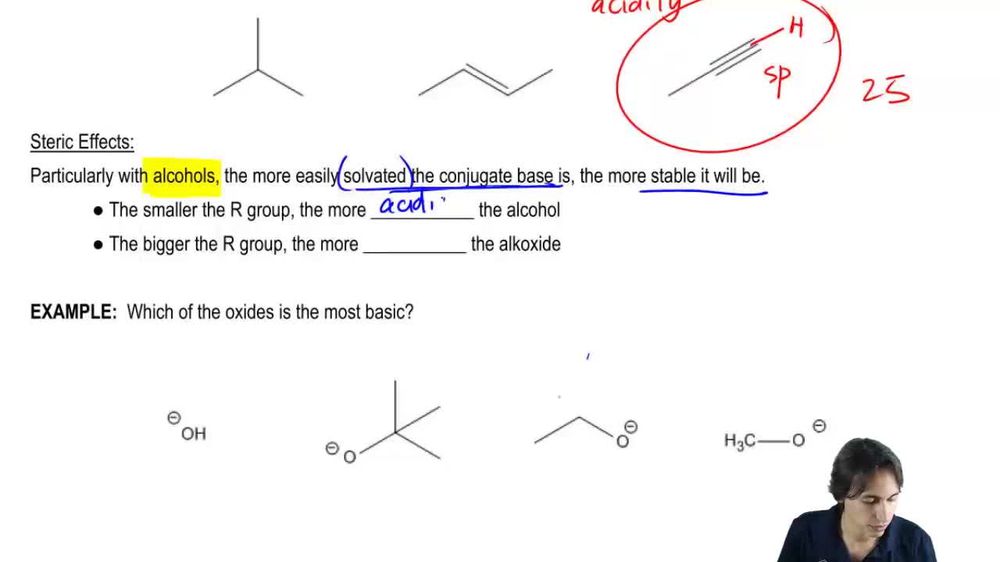
How to use the factors affecting acidity to predict leaving group ability.
Steric Hindrance
Steric hindrance refers to the prevention of reactions due to the spatial arrangement of atoms within a molecule. In the case of 2-chloro-3-methylbutane, the presence of a methyl group adjacent to the reactive center can create steric hindrance, making it more difficult for the nucleophile to approach and react with the carbon atom. This can lead to a slower reaction rate compared to less hindered substrates.

 5:01 minutes
 Verified step by step guidance
 01:47
01:47