Explain how each of the following changes affect the rate of the reaction of 1-bromobutane with ethoxide ion in DMF. a. The concentration of both the alkyl halide and the nucleophile are tripled. b. The solvent is changed to ethanol.
Verified step by step guidance
1
The reaction of 1-bromobutane with ethoxide ion in DMF is an example of an SN2 reaction. In an SN2 reaction, the rate is determined by the rate law: \( \text{Rate} = k[\text{1-bromobutane}][\text{ethoxide ion}] \). This means the reaction is second-order overall, depending on the concentrations of both the alkyl halide and the nucleophile.
a. If the concentration of both the alkyl halide (1-bromobutane) and the nucleophile (ethoxide ion) are tripled, substitute the new concentrations into the rate law. The new rate will be \( \text{Rate}_{\text{new}} = k(3[\text{1-bromobutane}])(3[\text{ethoxide ion}]) \). Simplify this to \( \text{Rate}_{\text{new}} = 9k[\text{1-bromobutane}][\text{ethoxide ion}] \). This shows that the rate of the reaction will increase by a factor of 9.
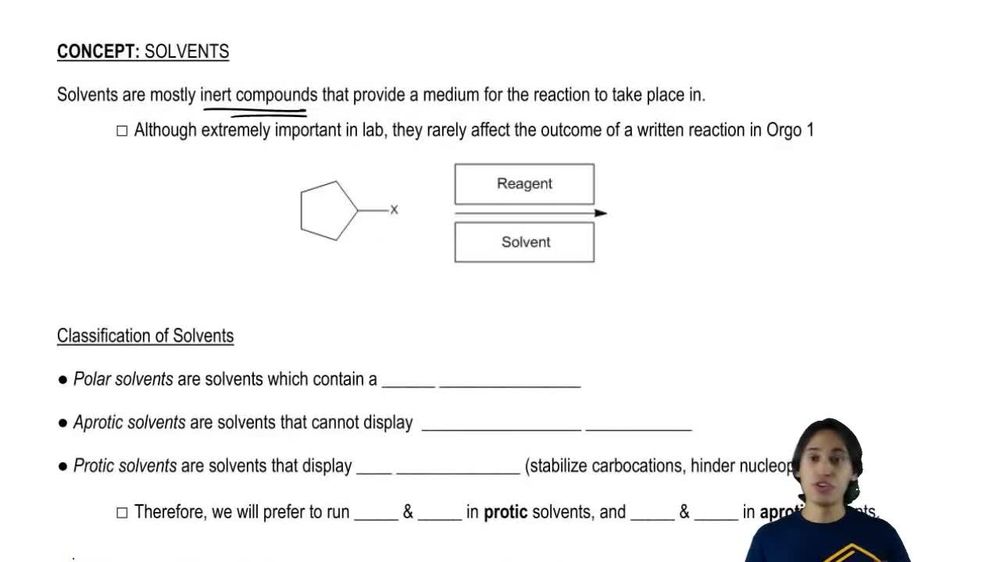
b. Changing the solvent to ethanol affects the reaction because ethanol is a protic solvent, whereas DMF is an aprotic solvent. In an SN2 reaction, aprotic solvents like DMF stabilize the nucleophile less, allowing it to remain more reactive. Protic solvents like ethanol, on the other hand, can hydrogen bond with the nucleophile, reducing its reactivity. This means the rate of the reaction will decrease when the solvent is changed to ethanol.
To summarize, the rate of the reaction is directly proportional to the concentrations of both the alkyl halide and the nucleophile, and the solvent choice significantly impacts the nucleophile's reactivity in an SN2 mechanism.
For part (a), the rate increases by a factor of 9 when concentrations are tripled. For part (b), the rate decreases when the solvent is changed to ethanol due to reduced nucleophilicity in a protic solvent.
Verified video answer for a similar problem:
This video solution was recommended by our tutors as helpful for the problem above
Video duration:
5m
Play a video:
0 Comments
Key Concepts
Here are the essential concepts you must grasp in order to answer the question correctly.
Nucleophilic Substitution Reactions
Nucleophilic substitution reactions involve the replacement of a leaving group in an organic molecule by a nucleophile. In the case of 1-bromobutane reacting with ethoxide ion, the reaction mechanism can be either SN1 or SN2, depending on factors like steric hindrance and solvent. Understanding the mechanism is crucial for predicting how changes in concentration and solvent will affect the reaction rate.
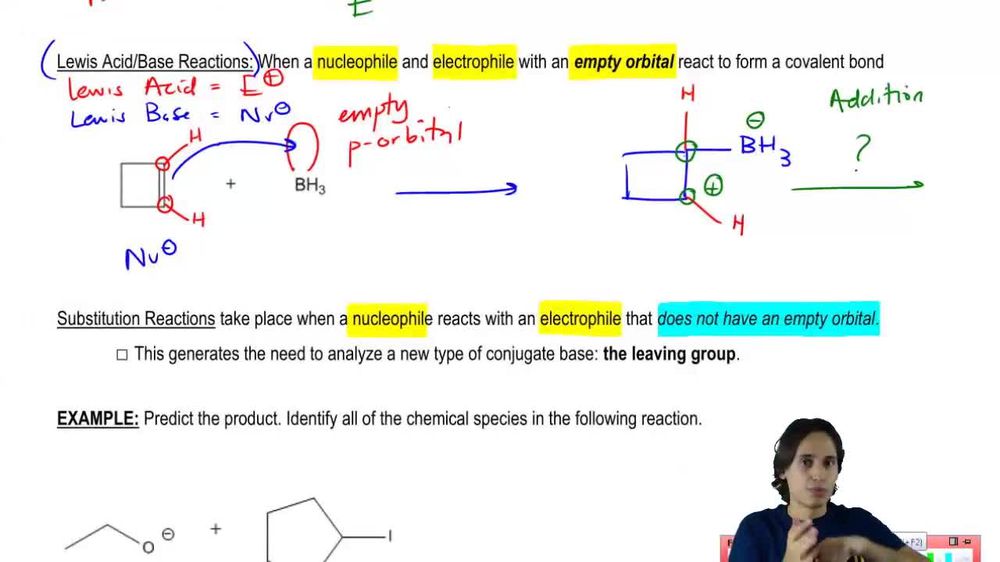
Nucleophiles and Electrophiles can react in Substitution Reactions.
Reaction Rate and Concentration
The rate of a chemical reaction is influenced by the concentrations of the reactants. For a bimolecular reaction like the SN2 mechanism, tripling the concentration of both the alkyl halide and the nucleophile will increase the reaction rate significantly, as the rate is directly proportional to the product of the concentrations of the two reactants. This relationship is described by the rate law for the reaction.
The choice of solvent can greatly influence the rate and mechanism of a nucleophilic substitution reaction. DMF (dimethylformamide) is a polar aprotic solvent that stabilizes ions and enhances nucleophilicity, favoring SN2 reactions. In contrast, ethanol is a polar protic solvent that can solvate nucleophiles and reduce their reactivity, potentially favoring an SN1 mechanism and slowing the reaction rate.