Formation of the molozonide can be expected to proceed stereospecifically. Why is this the case? Show the two different molozonides you would expect to get from ozonolysis of (E)- and (Z)-3,4-dimethylhept-3-ene.
Verified step by step guidance
1
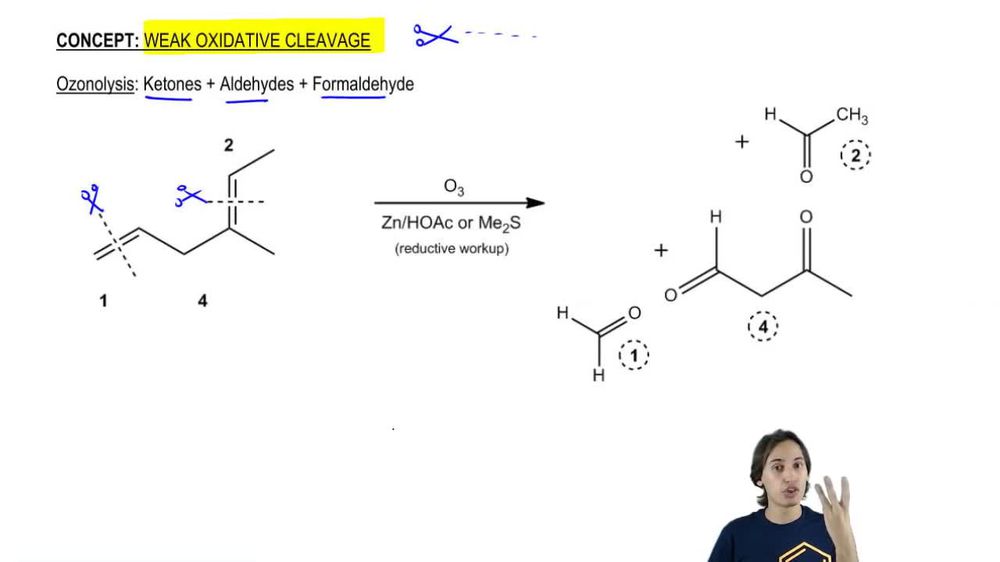
Understand the concept of ozonolysis: Ozonolysis is a reaction where ozone (O₃) cleaves alkenes to form carbonyl compounds. The initial step involves the formation of a molozonide, which is a cyclic intermediate.
Recognize stereospecificity: Stereospecific reactions lead to different stereoisomers depending on the configuration of the starting material. In this case, the stereochemistry of the alkene affects the stereochemistry of the molozonide formed.
Identify the starting materials: The problem involves (E)- and (Z)-3,4-dimethylhept-3-ene. The (E)-isomer has the two methyl groups on opposite sides of the double bond, while the (Z)-isomer has them on the same side.
Predict the molozonide formation: For the (E)-isomer, the molozonide will form with the substituents on opposite sides, maintaining the stereochemistry. For the (Z)-isomer, the molozonide will form with the substituents on the same side.
Draw the structures: Use the stereochemistry of the starting alkenes to draw the two different molozonides. Ensure that the cyclic structure reflects the stereochemistry of the original alkene, with the oxygen atoms forming a five-membered ring with the carbon atoms from the double bond.
Verified video answer for a similar problem:
This video solution was recommended by our tutors as helpful for the problem above
Video duration:
7m
Play a video:
0 Comments
Key Concepts
Here are the essential concepts you must grasp in order to answer the question correctly.
Ozonolysis
Ozonolysis is a reaction where ozone (O3) cleaves alkenes to form carbonyl compounds. It involves the formation of an intermediate called molozonide, which rearranges to form ozonide before breaking down into aldehydes or ketones. Understanding the mechanism of ozonolysis is crucial for predicting the stereochemistry of the products formed from different alkenes.
Stereospecificity refers to a reaction where the stereochemistry of the reactant determines the stereochemistry of the product. In the context of ozonolysis, the stereochemistry of the alkene (E or Z configuration) influences the formation of molozonide, leading to different stereochemical outcomes. This concept is essential for predicting the stereochemical nature of the molozonides formed from (E)- and (Z)-3,4-dimethylhept-3-ene.
E/Z isomerism is a type of stereoisomerism found in alkenes, where the spatial arrangement of substituents around the double bond differs. E (entgegen) isomers have substituents on opposite sides, while Z (zusammen) isomers have them on the same side. This isomerism affects the stereospecific formation of molozonides during ozonolysis, as the initial geometry of the alkene dictates the stereochemistry of the resulting products.