Predict the major products of the following reactions. (a) (E)-3-methyloct-3-ene + ozone, then (CH3)2S
Verified step by step guidance
1
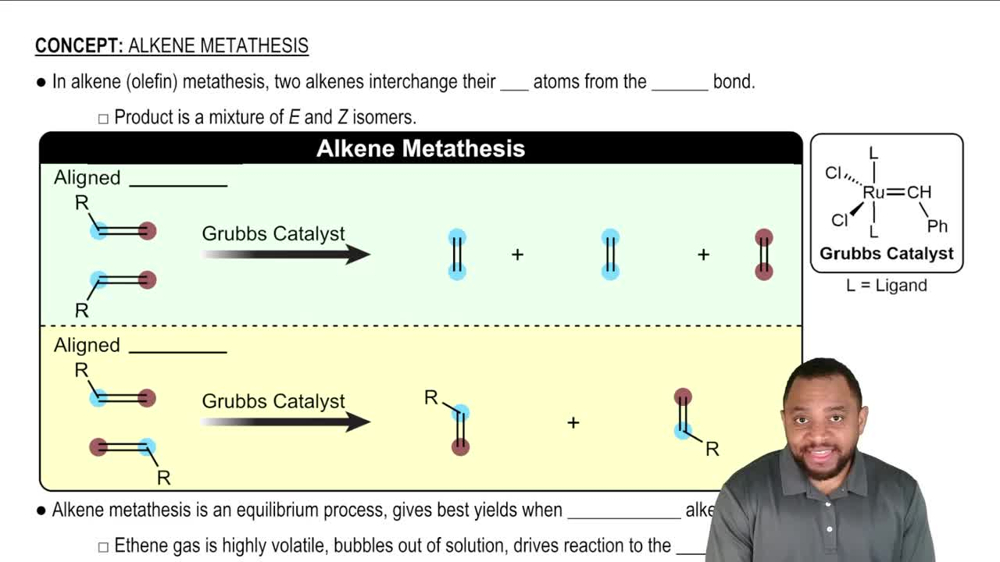
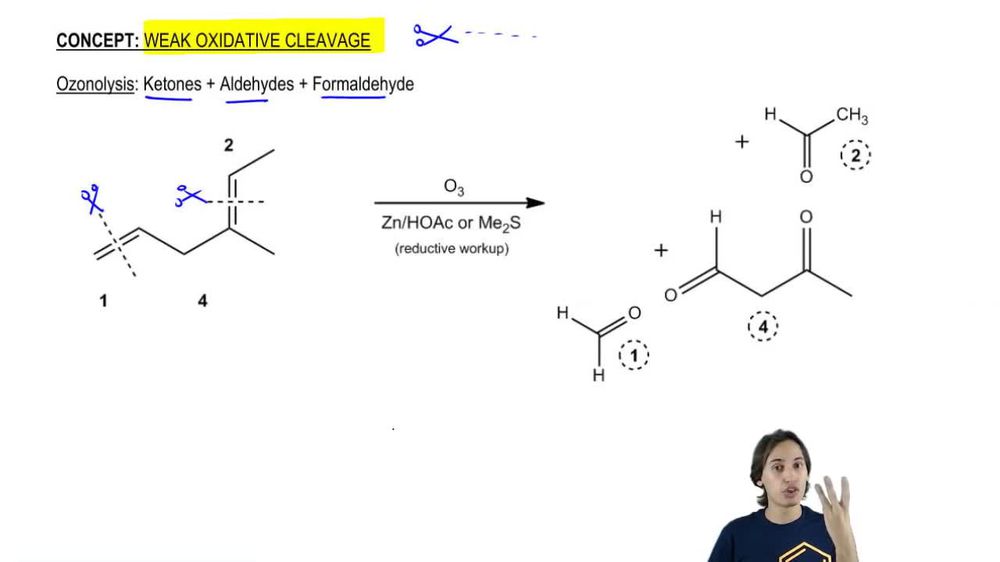
Step 1: Recognize the type of reaction. The problem involves ozonolysis, which is a reaction where ozone (O3) cleaves the double bond of an alkene, resulting in the formation of carbonyl compounds (aldehydes or ketones). The second reagent, (CH3)2S, is used to reduce the ozonide intermediate to the final products.
Step 2: Analyze the structure of the starting material. The given compound is (E)-3-methyloct-3-ene, which is an alkene with a double bond between the third and fourth carbons. The (E) configuration indicates that the substituents on the double bond are on opposite sides.
Step 3: Determine the cleavage points. Ozonolysis breaks the double bond entirely, splitting the molecule into two fragments at the site of the double bond. Each fragment will form a carbonyl group (either an aldehyde or a ketone) depending on the substituents attached to the carbons involved in the double bond.
Step 4: Assign the products based on the cleavage. After the double bond is cleaved, the carbon atoms involved in the double bond will each form a carbonyl group. Examine the substituents on these carbons to determine whether the products are aldehydes or ketones. For example, if a carbon is bonded to two alkyl groups, it will form a ketone; if it is bonded to one alkyl group and one hydrogen, it will form an aldehyde.
Step 5: Verify the stereochemistry and functional groups. Since the reaction involves breaking the double bond entirely, the stereochemistry of the original alkene does not affect the final products. Ensure that the products are correctly labeled as aldehydes or ketones based on the structure of the starting material.
Verified video answer for a similar problem:
This video solution was recommended by our tutors as helpful for the problem above
Video duration:
7m
Play a video:
0 Comments
Key Concepts
Here are the essential concepts you must grasp in order to answer the question correctly.
Ozonolysis
Ozonolysis is a reaction involving the cleavage of alkenes using ozone (O3) to form carbonyl compounds. In this process, the double bond of the alkene is oxidatively cleaved, resulting in the formation of aldehydes or ketones, depending on the structure of the starting alkene. The reaction typically proceeds through the formation of a molozonide intermediate, which rearranges to yield the final carbonyl products.
Different reagents can be used to oxidize alkenes, leading to various products. For instance, cold, dilute KMnO4 and OsO4-H2O2 are mild oxidants that add hydroxyl groups across the double bond, while warm, concentrated KMnO4 and ozone followed by (CH3)2S fully cleave the double bond, forming carbonyl groups. Understanding the specific action of these reagents is crucial for predicting the outcome of reactions involving alkenes.
The mechanism of alkene reactions involves the initial formation of a cyclic intermediate or a transition state that facilitates the addition of reagents across the double bond. For ozonolysis, the mechanism includes the formation of a molozonide, which rearranges to yield carbonyl compounds. Grasping these mechanisms helps in predicting the major products formed during the reaction and understanding the selectivity of different reagents.

 7:06 minutes
 Verified step by step guidance
 06:30
06:30