When compound Z is treated with ozone, followed by dimethyl sulfide and washing with water, the products are formic acid, 3-oxobutanoic acid, and hexanal. Propose a structure for compound Z. What uncertainty is there in the structure you have proposed?
Verified step by step guidance
1
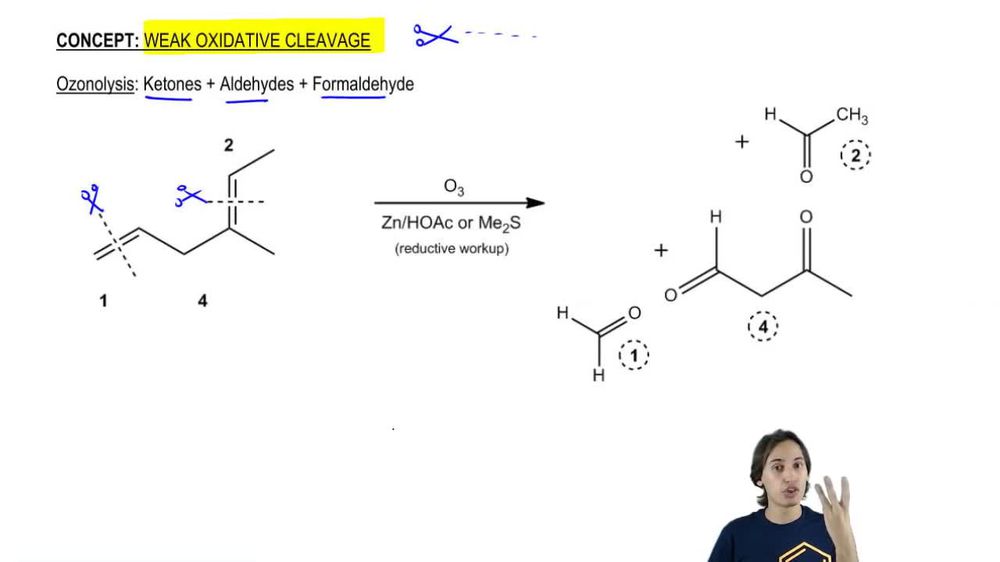
Step 1: Analyze the reaction conditions. The reaction involves ozonolysis, which cleaves double bonds in alkenes to form carbonyl compounds. The use of ozone (O₃) followed by dimethyl sulfide ((CH₃)₂S) indicates reductive ozonolysis, which produces aldehydes and ketones.
Step 2: Examine the products formed. The products are formic acid (HCOOH), 3-oxobutanoic acid (CH₃COCH₂COOH), and hexanal (CH₃(CH₂)₄CHO). These products suggest that compound Z contains multiple double bonds that are cleaved during ozonolysis.
Step 3: Deduce the structure of compound Z. To form these products, compound Z must have a structure where the double bonds are positioned such that cleavage results in the observed products. Specifically, the double bonds must be located to yield formic acid, 3-oxobutanoic acid, and hexanal upon cleavage.
Step 4: Propose a possible structure for compound Z. Based on the products, compound Z could be a polyunsaturated compound with double bonds at specific positions. For example, Z might be a molecule with the structure CH₂=CH-CH₂-CH=CH-(CH₂)₄-CH=CH₂, where ozonolysis cleaves the double bonds to yield the observed products.
Step 5: Address uncertainty in the proposed structure. The exact positions of the double bonds in compound Z may vary slightly, as the reaction conditions and steric factors could influence the cleavage pattern. Additional experimental data, such as NMR or IR spectroscopy, would be needed to confirm the precise structure of Z.
Verified video answer for a similar problem:
This video solution was recommended by our tutors as helpful for the problem above
Video duration:
10m
Play a video:
0 Comments
Key Concepts
Here are the essential concepts you must grasp in order to answer the question correctly.
Ozonolysis
Ozonolysis is a reaction involving the cleavage of alkenes or alkynes using ozone (O3) to form carbonyl compounds. In this process, the double or triple bond is oxidatively cleaved, resulting in the formation of aldehydes, ketones, or carboxylic acids, depending on the structure of the starting material. The reaction typically proceeds in two steps: initial formation of ozonides followed by reduction, often using dimethyl sulfide (DMS) or zinc.
Identifying functional groups is crucial in organic chemistry as they determine the chemical reactivity and properties of compounds. In the context of the products formed from ozonolysis, recognizing functional groups such as aldehydes, ketones, and carboxylic acids helps in deducing the structure of the original compound Z. Each functional group has distinct characteristics that influence the overall behavior of the molecule.
Structural ambiguity arises when multiple structures can explain the same set of products or reactions. In the case of compound Z, the formation of formic acid, 3-oxobutanoic acid, and hexanal suggests that several different structures could lead to these products through ozonolysis. This uncertainty necessitates careful consideration of possible isomers and the arrangement of atoms in the proposed structure to ensure all products are accounted for.

 10:11 minutes
 Verified step by step guidance
 06:30
06:30