Explain why amino acids, unlike most amines and carboxylic acids, are insoluble in diethyl ether.
Verified step by step guidance
1
Amino acids contain both an amine group (-NH₂) and a carboxylic acid group (-COOH) within the same molecule, making them amphoteric. This means they can act as both acids and bases depending on the pH of the environment.
In aqueous solutions, amino acids typically exist as zwitterions, where the amine group is protonated to form -NH₃⁺ and the carboxylic acid group is deprotonated to form -COO⁻. This zwitterionic form is highly polar.
Diethyl ether is a nonpolar solvent, meaning it cannot effectively solvate or stabilize the highly polar zwitterionic form of amino acids. Solubility depends on the ability of the solvent to interact with the solute, and in this case, diethyl ether lacks the necessary polarity.
In contrast, most simple amines and carboxylic acids do not form zwitterions and are less polar. They can interact with diethyl ether through weak van der Waals forces or hydrogen bonding, making them more soluble in this solvent.
Thus, the unique zwitterionic nature of amino acids, which makes them highly polar, is the primary reason they are insoluble in diethyl ether, a nonpolar solvent.
Verified video answer for a similar problem:
This video solution was recommended by our tutors as helpful for the problem above
Play a video:
0 Comments
Key Concepts
Here are the essential concepts you must grasp in order to answer the question correctly.
Polarity and Solubility
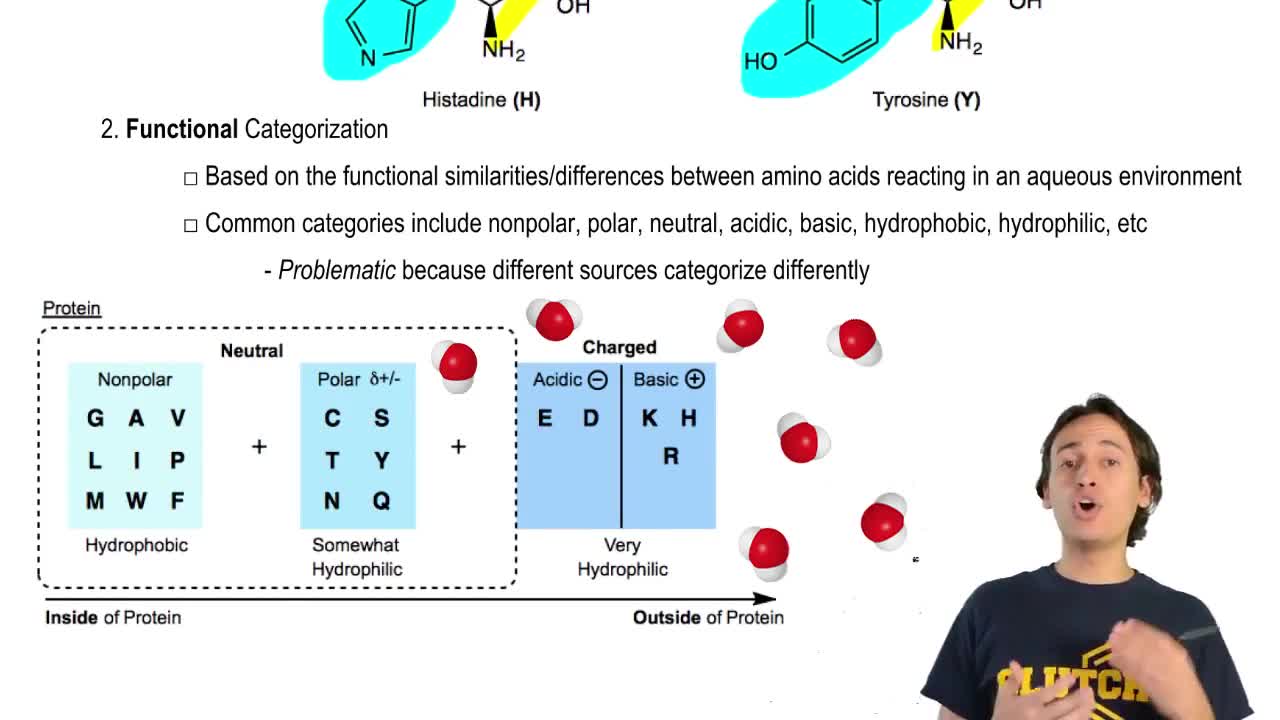
Solubility is largely determined by the polarity of a substance. Diethyl ether is a nonpolar solvent, which means it dissolves nonpolar substances well but struggles with polar compounds. Amino acids possess both polar (amino and carboxyl) and nonpolar (hydrophobic side chains) characteristics, but their overall structure often leads to stronger interactions with water than with diethyl ether, resulting in their insolubility in the latter.
Amino acids can form hydrogen bonds due to the presence of functional groups like -NH2 (amino) and -COOH (carboxyl). These interactions with water molecules enhance their solubility in polar solvents like water. In contrast, diethyl ether lacks the ability to form significant hydrogen bonds, making it less effective at solubilizing amino acids.
Amino acids have varying side chains that can be hydrophobic or hydrophilic. The hydrophilic (polar) parts of amino acids interact favorably with water, while the hydrophobic (nonpolar) parts do not interact well with polar solvents. In diethyl ether, the hydrophobic regions of amino acids do not engage effectively, leading to their overall insolubility in this nonpolar solvent.