For each of the following molecules, indicate the hybridization of each carbon and give the approximate values of all the bond angles: b. CH3CH═CH2
Verified step by step guidance
1
Step 1: Identify the structure of the molecule CH3CH═CH2. The molecule consists of three carbon atoms: one in a methyl group (CH3), one in a double bond (CH═), and one in a terminal double-bonded group (CH2).
Step 2: Determine the hybridization of each carbon atom. For the first carbon in CH3, it forms four single bonds (three with hydrogen and one with the second carbon). This indicates sp³ hybridization. For the second carbon in CH═, it forms three sigma bonds (one with the first carbon, one with the third carbon, and one with a hydrogen) and one pi bond. This indicates sp² hybridization. For the third carbon in CH2, it forms two sigma bonds (one with the second carbon and one with a hydrogen) and one pi bond. This also indicates sp² hybridization.
Step 3: Recall the bond angle associated with each hybridization. For sp³ hybridized carbons, the bond angles are approximately 109.5°. For sp² hybridized carbons, the bond angles are approximately 120°.
Step 4: Assign the bond angles to each carbon. The first carbon (sp³) has bond angles of approximately 109.5°. The second and third carbons (both sp²) have bond angles of approximately 120°.
Step 5: Summarize the results. The first carbon in CH3 is sp³ hybridized with bond angles of approximately 109.5°. The second carbon in CH═ is sp² hybridized with bond angles of approximately 120°. The third carbon in CH2 is sp² hybridized with bond angles of approximately 120°.
Verified video answer for a similar problem:
This video solution was recommended by our tutors as helpful for the problem above
Play a video:
0 Comments
Key Concepts
Here are the essential concepts you must grasp in order to answer the question correctly.
Hybridization
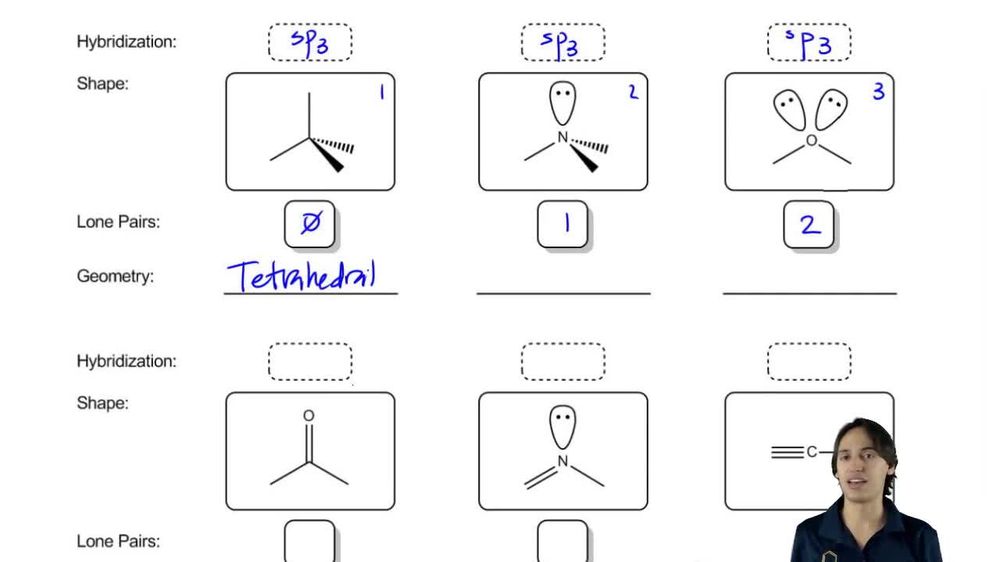
Hybridization is the concept of mixing atomic orbitals to form new hybrid orbitals that can accommodate the bonding requirements of a molecule. In organic chemistry, carbon typically undergoes sp3, sp2, or sp hybridization depending on its bonding environment. For example, sp3 hybridization occurs in tetrahedral geometries, sp2 in trigonal planar, and sp in linear arrangements.
Bond angles are the angles formed between adjacent bonds in a molecule, which are influenced by the hybridization of the atoms involved. For sp3 hybridized carbons, the bond angles are approximately 109.5 degrees; for sp2, they are about 120 degrees; and for sp, they are around 180 degrees. Understanding these angles helps predict the molecular geometry and reactivity.
Molecular geometry refers to the three-dimensional arrangement of atoms within a molecule. It is determined by the hybridization of the central atom and the presence of lone pairs. In the case of CH3CH═CH2, the geometry around the sp2 hybridized carbon atoms leads to a planar structure, which is crucial for understanding the molecule's reactivity and interactions.

 Verified step by step guidance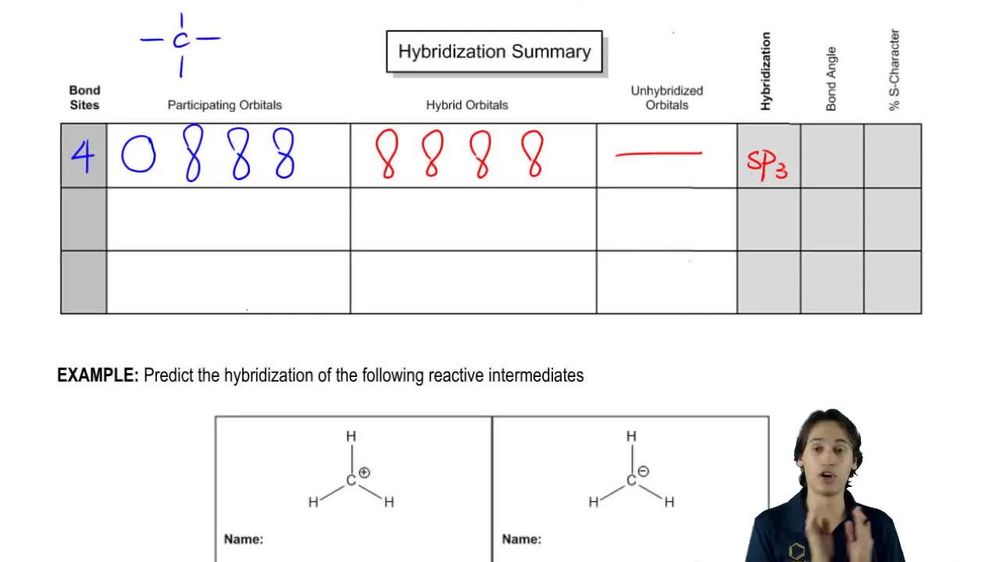
 10:43
10:43