a. Which of the species have bond angles of 109.5°? b. Which of the species have bond angles of 120°? NH3+NH4-CH3
Verified step by step guidance
1
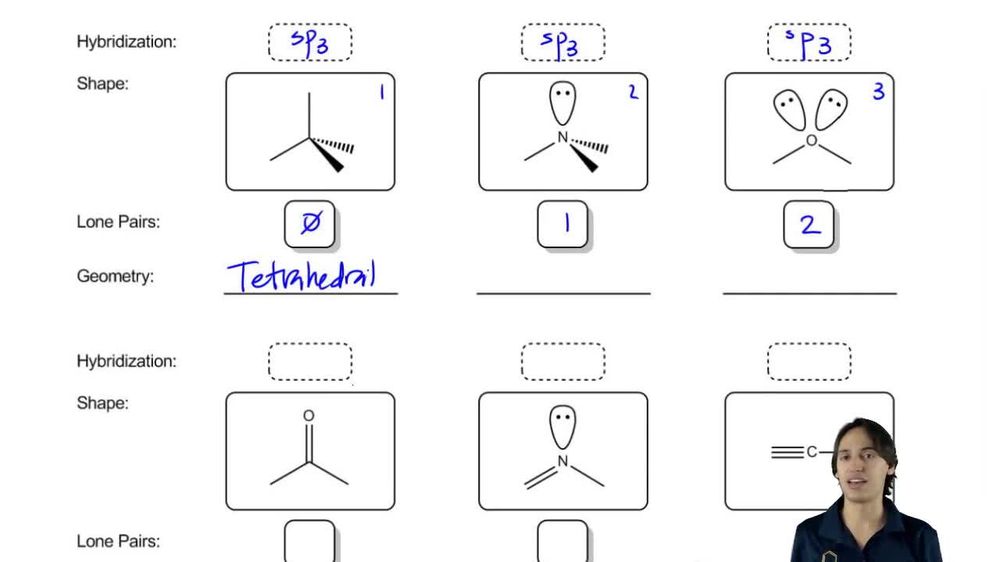
Step 1: Understand the bond angles in question. A bond angle of 109.5° is characteristic of a tetrahedral geometry, which occurs when a central atom is sp3 hybridized and surrounded by four regions of electron density. A bond angle of 120° is characteristic of a trigonal planar geometry, which occurs when a central atom is sp2 hybridized and surrounded by three regions of electron density.
Step 2: Analyze the geometry of NH3 (ammonia). NH3 has a central nitrogen atom bonded to three hydrogen atoms and one lone pair of electrons. The electron geometry is tetrahedral due to four regions of electron density, but the molecular geometry is trigonal pyramidal. The bond angles are slightly less than 109.5° due to lone pair repulsion.
Step 3: Analyze the geometry of +NH4 (ammonium ion). +NH4 has a central nitrogen atom bonded to four hydrogen atoms with no lone pairs. The electron geometry and molecular geometry are both tetrahedral, resulting in bond angles of 109.5°.
Step 4: Analyze the geometry of -CH3 (methyl anion). -CH3 has a central carbon atom bonded to three hydrogen atoms and one lone pair of electrons. The electron geometry is tetrahedral, but the molecular geometry is trigonal pyramidal. The bond angles are slightly less than 109.5° due to lone pair repulsion.
Step 5: Summarize the findings. +NH4 has bond angles of 109.5° due to its perfect tetrahedral geometry. NH3 and -CH3 have bond angles slightly less than 109.5° due to lone pair repulsion. None of the species have bond angles of 120°, as none exhibit trigonal planar geometry.
Verified video answer for a similar problem:
This video solution was recommended by our tutors as helpful for the problem above
Play a video:
0 Comments
Key Concepts
Here are the essential concepts you must grasp in order to answer the question correctly.
Tetrahedral Geometry
Tetrahedral geometry occurs when a central atom is bonded to four other atoms, resulting in bond angles of approximately 109.5°. This arrangement minimizes electron pair repulsion according to VSEPR (Valence Shell Electron Pair Repulsion) theory, leading to a three-dimensional shape where the atoms are positioned at the corners of a tetrahedron.
Trigonal planar geometry is characterized by a central atom bonded to three other atoms, forming bond angles of 120°. This geometry arises when there are no lone pairs on the central atom, allowing the bonded atoms to spread out evenly in a flat, triangular shape, which also minimizes electron pair repulsion.
VSEPR (Valence Shell Electron Pair Repulsion) theory is a model used to predict the geometry of molecules based on the repulsion between electron pairs surrounding a central atom. According to this theory, the spatial arrangement of atoms is determined by the need to minimize repulsion between electron pairs, leading to specific bond angles and molecular shapes.