Which of the following indicated atoms would you expect to be most basic? (a)
Verified step by step guidance
1
Step 1: Understand the concept of basicity. Basicity refers to the ability of an atom or molecule to donate a pair of electrons to accept a proton (H⁺). The more readily an atom can donate its lone pair of electrons, the more basic it is.
Step 2: Analyze the electronic environment of the indicated atoms. Factors such as electronegativity, resonance, hybridization, and steric hindrance can influence the availability of the lone pair of electrons for protonation.
Step 3: Compare the electronegativity of the atoms. Atoms with lower electronegativity tend to hold their electrons less tightly, making them more likely to donate their lone pair and thus more basic.
Step 4: Consider resonance effects. If the lone pair of electrons on an atom is delocalized through resonance, it becomes less available for protonation, reducing the basicity of that atom.
Step 5: Evaluate hybridization. Atoms with sp³ hybridization are generally more basic than those with sp² or sp hybridization because the lone pair is held farther from the nucleus and is more available for donation.
Verified video answer for a similar problem:
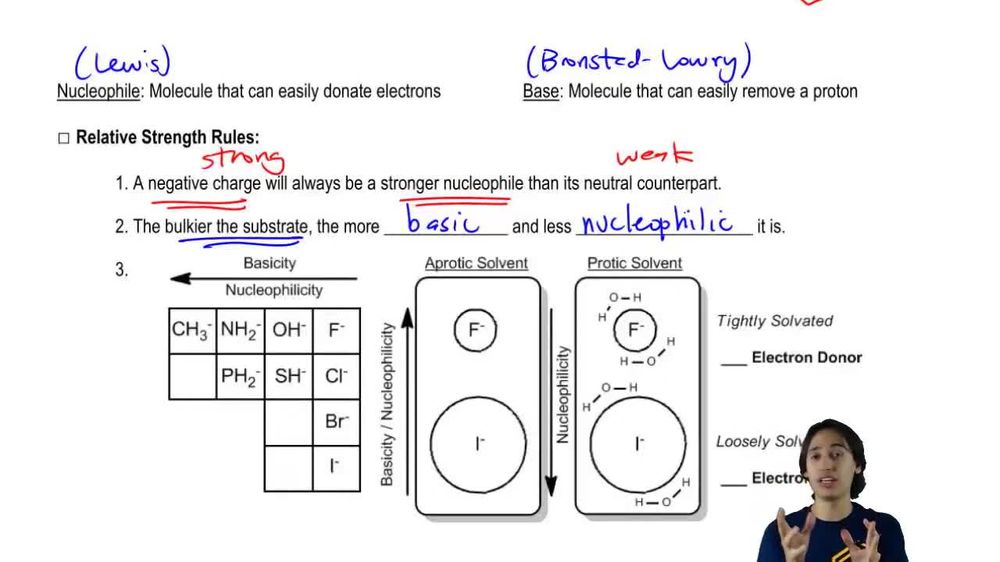
This video solution was recommended by our tutors as helpful for the problem above
Video duration:
3m
Play a video:
0 Comments
Key Concepts
Here are the essential concepts you must grasp in order to answer the question correctly.
Basicity
Basicity refers to the ability of a substance to accept protons (H+) or donate electron pairs. In organic chemistry, basicity is influenced by the structure of the molecule, including the presence of electronegative atoms and the availability of lone pairs. Stronger bases are typically associated with less electronegative atoms that can stabilize the positive charge after protonation.
Understanding the difference between basicity and nucleophilicity.
Electronegativity
Electronegativity is a measure of an atom's ability to attract and hold onto electrons. In the context of basicity, more electronegative atoms tend to hold onto their electrons more tightly, making them less likely to donate electron pairs or accept protons. Understanding the electronegativity of the atoms in question is crucial for predicting their basicity.
Resonance stabilization occurs when a molecule can be represented by multiple valid Lewis structures, allowing for the delocalization of electrons. This delocalization can affect basicity; for example, if a lone pair is involved in resonance, it may be less available to accept a proton, thus decreasing the basicity of the atom. Recognizing resonance structures is essential for evaluating the basicity of different atoms.