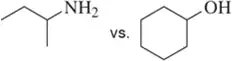
Without using pKa values, pick out the more acidic compound in each pair. Explain your answer. (a)
Verified step by step guidance
1
Step 1: Understand the concept of acidity. Acidity in organic compounds is determined by the ability of a molecule to donate a proton (H⁺). The stability of the conjugate base formed after losing the proton plays a key role in determining acidity.
Step 2: Analyze the structural features of the compounds in the pair. Look for factors such as electronegativity, resonance stabilization, inductive effects, and hybridization of the atom bonded to the acidic proton.
Step 3: Consider electronegativity. A proton attached to a more electronegative atom is more acidic because the electronegative atom stabilizes the negative charge on the conjugate base.
Step 4: Evaluate resonance effects. If the conjugate base can delocalize its negative charge through resonance, the compound is more acidic. Compare the resonance structures of the conjugate bases of the two compounds.
Step 5: Examine inductive effects and hybridization. Electron-withdrawing groups near the acidic proton increase acidity by stabilizing the conjugate base through inductive effects. Additionally, a proton attached to an sp-hybridized atom is more acidic than one attached to an sp² or sp³ atom due to the higher electronegativity of sp-hybridized atoms.
Verified video answer for a similar problem:
This video solution was recommended by our tutors as helpful for the problem above
Video duration:
3m
Play a video:
0 Comments
Key Concepts
Here are the essential concepts you must grasp in order to answer the question correctly.
Acidity and Proton Donation
Acidity in organic chemistry refers to the ability of a compound to donate a proton (H⁺) to a base. The more readily a compound can lose a proton, the stronger its acidity. Factors influencing acidity include the stability of the resulting anion after proton donation and the electronegativity of atoms bonded to the acidic hydrogen.
Resonance stabilization occurs when a compound can be represented by multiple valid Lewis structures, allowing for the delocalization of electrons. This delocalization can stabilize the negative charge on the conjugate base formed after proton donation, making the original compound more acidic. Compounds with greater resonance stabilization of their conjugate bases are typically more acidic.
The inductive effect refers to the electron-withdrawing or electron-donating effects of substituents attached to a molecule. Electronegative atoms or groups can stabilize the negative charge of a conjugate base through the inductive effect, enhancing acidity. The presence of such groups near the acidic hydrogen can significantly influence the compound's acidity.