Predict the product of the following epoxide opening reactions. (b)
Verified step by step guidance
1
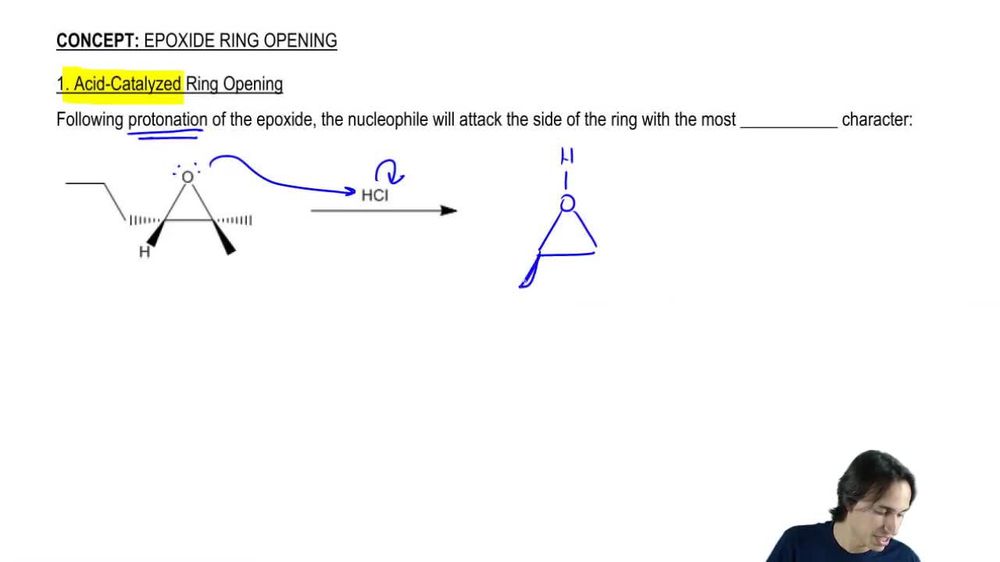
Identify the structure of the epoxide. An epoxide is a cyclic ether with a three-membered ring, typically consisting of two carbon atoms and one oxygen atom.
Determine the conditions of the reaction. Epoxide opening can occur under acidic or basic conditions, which will influence the regioselectivity and stereochemistry of the product.
If the reaction is under acidic conditions, the nucleophile will attack the more substituted carbon atom due to the formation of a more stable carbocation intermediate. If under basic conditions, the nucleophile will attack the less substituted carbon atom due to direct SN2 attack.
Consider the stereochemistry of the reaction. Epoxide opening reactions often result in inversion of configuration at the carbon atom where the nucleophile attacks, due to the backside attack characteristic of SN2 reactions.
Draw the product of the reaction, ensuring to show the correct regioselectivity and stereochemistry based on the conditions provided. Include any additional substituents or groups that may be present in the reaction.
Verified video answer for a similar problem:
This video solution was recommended by our tutors as helpful for the problem above
Video duration:
3m
Play a video:
0 Comments
Key Concepts
Here are the essential concepts you must grasp in order to answer the question correctly.
Epoxide Structure and Reactivity
Epoxides are three-membered cyclic ethers with significant ring strain, making them highly reactive. The strained ring is prone to nucleophilic attack, leading to ring opening. Understanding the structure and reactivity of epoxides is crucial for predicting the outcome of their reactions, as the nucleophile will typically attack the less hindered carbon atom in the ring.
Regioselectivity refers to the preference for a chemical reaction to occur at one direction or position over others. In epoxide opening, the regioselectivity is influenced by the nature of the nucleophile and the reaction conditions. Under acidic conditions, the nucleophile attacks the more substituted carbon, while under basic conditions, it attacks the less substituted carbon, affecting the final product.
Stereochemistry involves the spatial arrangement of atoms in molecules and its impact on chemical reactions. In epoxide opening, the stereochemistry of the starting material and the reaction conditions determine the stereochemical outcome. The nucleophilic attack typically occurs from the opposite side of the leaving group, leading to an inversion of configuration at the carbon center, which is crucial for predicting the stereochemistry of the product.

 3:35 minutes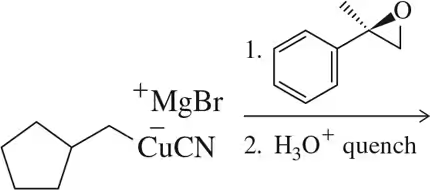
 Verified step by step guidance
 02:19
02:19