Step 1: Identify the longest continuous carbon chain that contains the hydroxyl (-OH) group. This will serve as the parent chain for naming the compound.
Step 2: Number the carbon atoms in the parent chain starting from the end closest to the hydroxyl group. This ensures the hydroxyl group gets the lowest possible number.
Step 3: Identify and name any substituents (branches or functional groups) attached to the parent chain. In this case, there is a double bond present, which must also be considered in the naming.
Step 4: Combine the names of the substituents, the position of the hydroxyl group, and the parent chain name. Use the suffix '-ol' to indicate the presence of the hydroxyl group and '-ene' to indicate the double bond. Ensure proper placement of numbers to indicate the positions of the functional groups and substituents.
Step 5: Double-check the name for compliance with IUPAC rules, ensuring that all functional groups and substituents are correctly prioritized and numbered.
Verified video answer for a similar problem:
This video solution was recommended by our tutors as helpful for the problem above
Video duration:
4m
Play a video:
0 Comments
Key Concepts
Here are the essential concepts you must grasp in order to answer the question correctly.
Functional Groups
Functional groups are specific groups of atoms within molecules that are responsible for the characteristic chemical reactions of those molecules. Understanding functional groups is essential in organic chemistry as they dictate the behavior and properties of organic compounds. Common examples include hydroxyl (-OH), carboxyl (-COOH), and amino (-NH2) groups.
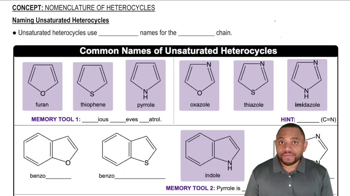
Nomenclature in organic chemistry refers to the systematic naming of organic compounds based on established rules. The International Union of Pure and Applied Chemistry (IUPAC) provides guidelines for naming compounds, which include identifying the longest carbon chain, determining the functional groups, and assigning locants to indicate the position of substituents. Mastery of nomenclature is crucial for clear communication and understanding of organic structures.
Structural isomerism occurs when compounds have the same molecular formula but different structural arrangements of atoms. This can lead to variations in physical and chemical properties. Understanding structural isomerism is important for identifying and naming compounds, as well as predicting their reactivity and interactions in chemical reactions.