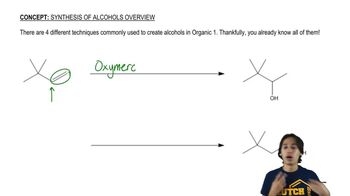
Predict the product of each of the following alcohol synthesis reactions. (d)
Verified step by step guidance
1
Identify the type of alcohol synthesis reaction. Common methods include hydroboration-oxidation, oxymercuration-demercuration, or reduction of carbonyl compounds. Determine which method is being used in this specific reaction.
Analyze the starting material. If the starting material is an alkene, the reaction might involve hydroboration-oxidation or oxymercuration-demercuration. If the starting material is a carbonyl compound (aldehyde or ketone), the reaction might involve reduction using reagents like NaBH₄ or LiAlH₄.
Determine the regioselectivity and stereoselectivity of the reaction. For example, hydroboration-oxidation adds the hydroxyl group (-OH) to the less substituted carbon (anti-Markovnikov), while oxymercuration-demercuration adds it to the more substituted carbon (Markovnikov). Reduction of carbonyl compounds typically forms a primary or secondary alcohol depending on the starting material.
Write the intermediate steps of the reaction mechanism. For example, in hydroboration-oxidation, the alkene reacts with BH₃ to form a trialkylborane intermediate, which is then oxidized with H₂O₂/NaOH to yield the alcohol.
Draw the final product, ensuring that the correct functional group (alcohol) is placed at the appropriate position on the molecule, and confirm the stereochemistry if applicable.
Verified video answer for a similar problem:
This video solution was recommended by our tutors as helpful for the problem above
Video duration:
2m
Play a video:
0 Comments
Key Concepts
Here are the essential concepts you must grasp in order to answer the question correctly.
Alcohol Synthesis
Alcohol synthesis refers to the various chemical reactions and methods used to produce alcohols from different starting materials. Common methods include the reduction of carbonyl compounds, hydration of alkenes, and the reaction of alkyl halides with nucleophiles. Understanding the mechanisms and conditions of these reactions is crucial for predicting the products formed.
Forming alcohols through Oxymercuration-Reduction.
Reaction Mechanisms
A reaction mechanism is a step-by-step description of the process by which reactants are converted into products. It includes the identification of intermediates, transition states, and the sequence of bond-breaking and bond-forming events. Familiarity with mechanisms helps in predicting the outcome of reactions, including the formation of alcohols.
Functional group transformation involves the conversion of one functional group into another through chemical reactions. In the context of alcohol synthesis, this may include the conversion of alkenes to alcohols via hydration or the reduction of carbonyls. Recognizing how different functional groups can be interconverted is essential for predicting the products of synthesis reactions.

