Ch. 9 - Substitution and Elimination Reactions of Alkyl Halides
Bruice - Organic Chemistry 8th Edition
Bruice8th EditionOrganic ChemistryISBN: 9780135213711Not the one you use?Change textbook
Chapter 10, Problem 77c,d

Draw the substitution products for each of the following reactions; if the products can exist as stereoisomers, show what stereoisomers are obtained:
c. benzyl chloride + CH3CH2OH
d. allyl chloride + CH3OH

Verified step by step guidance
1
Identify the type of reaction: Both reactions involve alkyl halides (benzyl chloride and allyl chloride) reacting with alcohols (CH3CH2OH and CH3OH). These are nucleophilic substitution reactions, which can proceed via either the SN1 or SN2 mechanism depending on the structure of the alkyl halide.
Analyze the structure of the alkyl halides: Benzyl chloride has a benzyl group (C6H5CH2-) attached to the chlorine atom, which stabilizes a carbocation intermediate due to resonance. Allyl chloride has an allyl group (CH2=CH-CH2-) attached to the chlorine atom, which also stabilizes a carbocation intermediate via resonance. Both are likely to proceed via the SN1 mechanism.
Determine the nucleophile and solvent: The alcohols (CH3CH2OH and CH3OH) act as both the nucleophile and the solvent in these reactions. In an SN1 reaction, the alcohol will attack the carbocation intermediate formed after the departure of the chloride ion (Cl⁻).
Predict the substitution products: For benzyl chloride + CH3CH2OH, the product will be benzyl ethyl ether (C6H5CH2OCH2CH3). For allyl chloride + CH3OH, the product will be allyl methyl ether (CH2=CH-CH2OCH3).
Consider stereoisomers: In the case of benzyl chloride, the carbocation intermediate is planar and symmetric due to resonance, so no stereoisomers are formed. For allyl chloride, the product does not involve a stereogenic center, so no stereoisomers are formed here either.

Verified video answer for a similar problem:

This video solution was recommended by our tutors as helpful for the problem above.
Video duration:
5m
Was this helpful?

Key Concepts

Here are the essential concepts you must grasp in order to answer the question correctly.

Nucleophilic Substitution Reactions

Nucleophilic substitution reactions involve the replacement of a leaving group in a molecule by a nucleophile. In the given reactions, benzyl chloride and allyl chloride serve as substrates, while ethanol and methanol act as nucleophiles. Understanding the mechanism (either SN1 or SN2) is crucial, as it influences the reaction pathway and the stereochemistry of the products.
Recommended video:
Guided course
01:47
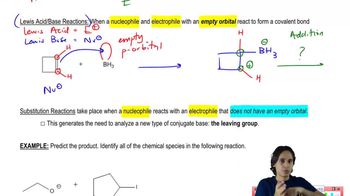
Nucleophiles and Electrophiles can react in Substitution Reactions.

Stereochemistry and Stereoisomers

Stereochemistry refers to the spatial arrangement of atoms in molecules and how this affects their chemical properties. In reactions that produce chiral centers, stereoisomers can form, which are molecules that have the same molecular formula but differ in the orientation of their atoms in space. Recognizing potential stereoisomers is essential for accurately depicting the products of the reactions.
Recommended video:
1:38
Polymer Stereochemistry Concept 1

Chirality and Chiral Centers

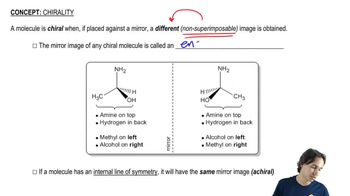
Chirality is a property of a molecule that makes it non-superimposable on its mirror image, often due to the presence of a chiral center, typically a carbon atom bonded to four different substituents. In the context of the reactions provided, identifying chiral centers in the substitution products is important for determining the possible stereoisomers that can be formed, which can significantly affect the reactivity and properties of the compounds.
Recommended video:
Guided course
05:10
What is chirality?
Related Practice
Textbook Question

Draw the substitution products for each of the following reactions; if the products can exist as stereoisomers, show what stereoisomers are obtained:

e. 1-bromo-2-butene + CH3O

f. 1-bromo-2-butene + CH3OH

889
views
Textbook Question

Draw the substitution products for each of the following reactions; if the products can exist as stereoisomers, show what stereoisomers are obtained:

a. (R)-2-bromopentane+CH3O

b. (R)-3-bromo-3-methylheptane+CH3OH

1584
views
Textbook Question

The pKa of acetic acid in water is 4.76. What effect will a decrease in the polarity of the solvent have on the pKa? Why?

1150
views
Textbook Question

Alkylbenzyldimethyl ammonium chloride is a leave-on skin antiseptic used to treat such things as cuts and cold sores. It is also the antiseptic in many hand sanitizers. It is actually a mixture of compounds that differ in the number of carbons (any even number between 8 and 18) in the alkyl group. Show three different sets of reagents (each set composed of an alkyl chloride and an amine) that can be used to synthesize the alkylbenzyldimethyl ammonium chloride shown here.

795
views
Textbook Question

Would you expect methoxide ion to be a better nucleophile if it is dissolved in CH3OH or if it is dissolved in DMSO? Why?

795
views
Textbook Question

a. Identify the substitution products that form when 2-bromo-2-methylpropane is dissolved in a mixture of 80% ethanol and 20% water.

b. Explain why the same products are obtained when 2-chloro-2-methylpropane is dissolved in a mixture of 80% ethanol and 20% water.

1367
views