Ch. 9 - Substitution and Elimination Reactions of Alkyl Halides
Bruice - Organic Chemistry 8th Edition
Bruice8th EditionOrganic ChemistryISBN: 9780135213711Not the one you use?Change textbook
Chapter 10, Problem 76

a. Identify the substitution products that form when 2-bromo-2-methylpropane is dissolved in a mixture of 80% ethanol and 20% water.
b. Explain why the same products are obtained when 2-chloro-2-methylpropane is dissolved in a mixture of 80% ethanol and 20% water.

Verified step by step guidance
1
Step 1: Recognize that 2-bromo-2-methylpropane is a tertiary alkyl halide. Tertiary alkyl halides typically undergo substitution reactions via the SN1 mechanism in polar protic solvents like ethanol and water.
Step 2: In the SN1 mechanism, the reaction begins with the ionization of the alkyl halide. The C-Br bond breaks heterolytically, forming a carbocation (2-methyl-2-propyl carbocation) and a bromide ion (Br⁻). Write the ionization step as: \( \text{(CH}_3\text{)}_3\text{CBr} \rightarrow \text{(CH}_3\text{)}_3\text{C}^+ + \text{Br}^- \).
Step 3: The carbocation formed is stabilized by the inductive and hyperconjugative effects of the three methyl groups. The nucleophiles present in the solvent mixture (ethanol and water) can now attack the carbocation. Ethanol (\( \text{CH}_3\text{CH}_2\text{OH} \)) and water (\( \text{H}_2\text{O} \)) are both nucleophiles, and they will form substitution products by bonding to the carbocation.
Step 4: The substitution products formed are tert-butyl ethyl ether (\( \text{(CH}_3\text{)}_3\text{COCH}_2\text{CH}_3 \)) when ethanol acts as the nucleophile, and tert-butyl alcohol (\( \text{(CH}_3\text{)}_3\text{COH} \)) when water acts as the nucleophile. These are the major products of the reaction.
Step 5: For part b, the same products are obtained with 2-chloro-2-methylpropane because it is also a tertiary alkyl halide. The SN1 mechanism is favored in both cases due to the stability of the carbocation intermediate and the polar protic solvent mixture. The only difference is the leaving group (Cl⁻ vs. Br⁻), but both are good leaving groups, so the reaction proceeds similarly.

Verified video answer for a similar problem:

This video solution was recommended by our tutors as helpful for the problem above.
Video duration:
6m
Was this helpful?

Key Concepts

Here are the essential concepts you must grasp in order to answer the question correctly.

Nucleophilic Substitution Reactions

Nucleophilic substitution reactions involve the replacement of a leaving group in a molecule by a nucleophile. In the case of 2-bromo-2-methylpropane and 2-chloro-2-methylpropane, the nucleophile is the solvent mixture of ethanol and water. The reaction can proceed via either the SN1 or SN2 mechanism, depending on the substrate structure and reaction conditions.
Recommended video:
Guided course
01:47
Nucleophiles and Electrophiles can react in Substitution Reactions.

SN1 vs. SN2 Mechanisms

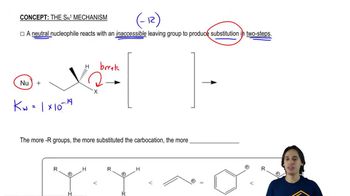
The SN1 mechanism is a two-step process where the leaving group departs first, forming a carbocation intermediate, followed by nucleophilic attack. In contrast, the SN2 mechanism is a one-step process where the nucleophile attacks the substrate simultaneously as the leaving group departs. The structure of 2-bromo-2-methylpropane and 2-chloro-2-methylpropane favors the SN1 pathway due to steric hindrance, leading to similar products.
Recommended video:
Guided course
10:49
Drawing the SN1 Mechanism

Solvent Effects on Reaction Pathways

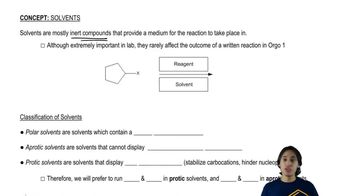
The choice of solvent can significantly influence the pathway of nucleophilic substitution reactions. A polar protic solvent, like the ethanol-water mixture, stabilizes carbocations and promotes the SN1 mechanism. This stabilization allows for the formation of similar substitution products from both 2-bromo-2-methylpropane and 2-chloro-2-methylpropane, as the solvent facilitates the reaction by solvating the ions formed during the process.
Recommended video:
Guided course
02:26
General format of reactions and how to interpret solvents.