Rank the following anions based on their stability as potential leaving groups. Explain your reasoning (1 = most stable ; 5 = least stable).
Verified step by step guidance
1
Identify the anions provided in the problem. Common leaving groups include halides (e.g., Cl⁻, Br⁻, I⁻), hydroxide (OH⁻), and others. Stability as a leaving group is often related to the ability of the anion to stabilize negative charge.
Recall the general trend for leaving group stability: the better the leaving group, the more stable the anion. Stability is influenced by factors such as electronegativity, size, resonance stabilization, and inductive effects.
Compare the electronegativity of the atoms in the anions. More electronegative atoms stabilize negative charge better, making the anion a better leaving group. For example, I⁻ is more stable than Cl⁻ because iodine is larger and can better disperse the negative charge.
Consider resonance effects. Anions that can delocalize their negative charge through resonance are more stable. For example, a carboxylate ion (RCOO⁻) is more stable than a hydroxide ion (OH⁻) due to resonance stabilization.
Evaluate inductive effects. Electronegative atoms or groups near the negative charge can stabilize the anion through electron withdrawal. For example, trifluoromethanesulfonate (CF₃SO₃⁻) is highly stable due to the strong electron-withdrawing effect of the fluorine atoms.
Verified video answer for a similar problem:
This video solution was recommended by our tutors as helpful for the problem above
Video duration:
9m
Play a video:
0 Comments
Key Concepts
Here are the essential concepts you must grasp in order to answer the question correctly.
Leaving Group Ability
Leaving group ability refers to the tendency of an atom or group of atoms to depart from a molecule during a chemical reaction. A good leaving group is typically stable after departure, often being a weak base. Common examples include halides and sulfonate groups, which can stabilize the negative charge effectively, making them favorable in nucleophilic substitution reactions.
How to use the factors affecting acidity to predict leaving group ability.
Anion Stability
Anion stability is influenced by several factors, including electronegativity, resonance, and the size of the atom bearing the negative charge. Generally, larger anions can better stabilize negative charges due to their ability to spread out the charge over a larger volume. Additionally, resonance can delocalize the negative charge, further enhancing stability.
Electronegativity is the tendency of an atom to attract electrons towards itself. In the context of anions, more electronegative atoms can stabilize negative charges more effectively. When ranking anions, those with higher electronegativity may be less stable as leaving groups compared to those that can distribute the charge more evenly or are less electronegative, thus influencing their overall stability.

 9:08 minutes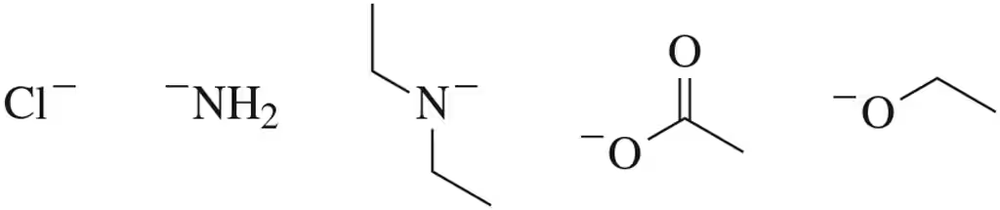
 Verified step by step guidance

 03:06
03:06

