Ch. 13 - Alcohols, Ethers and Related Compounds: Substitution and Elimination
Mullins - Organic Chemistry: A Learner Centered Approach 1st Edition
Mullins1st EditionOrganic Chemistry: A Learner Centered ApproachISBN: 9780137566471Not the one you use?Change textbook
Chapter 12, Problem 19

In contrast to the results of Assessment 13.18, when a secondary haloalkane is treated with sodium ethanethiolate, we predict formation of a thioether. How is this rationalized?
Chemical reaction diagram showing a secondary haloalkane reacting with sodium ethanethiolate to form a thioether.

Verified step by step guidance
1
Step 1: Recognize the type of reaction occurring. The reaction involves a secondary haloalkane (cyclopentyl bromide) reacting with sodium ethanethiolate (NaSCH2CH3) in ethanol. This is a nucleophilic substitution reaction.
Step 2: Identify the nucleophile and electrophile. Sodium ethanethiolate provides the nucleophile (ethanethiolate ion, SCH2CH3), which is a strong nucleophile due to the high nucleophilicity of sulfur. The electrophile is the secondary haloalkane (cyclopentyl bromide), where the carbon attached to bromine is electron-deficient and susceptible to attack.
Step 3: Rationalize the mechanism. The ethanethiolate ion attacks the carbon bonded to bromine in the secondary haloalkane. Bromine, being a good leaving group, departs, resulting in the formation of a new C-S bond. This is an SN2 mechanism, as the reaction occurs in a single step with backside attack by the nucleophile.
Step 4: Consider steric and electronic factors. Secondary haloalkanes can undergo SN2 reactions if steric hindrance is not excessive. In this case, the cyclopentyl structure is not overly hindered, allowing the ethanethiolate ion to approach and displace bromine effectively.
Step 5: Predict the product. The result of the reaction is the formation of a thioether (cyclopentyl ethyl sulfide), where the sulfur atom is bonded to the cyclopentyl group and the ethyl group. This is consistent with the nucleophilic substitution mechanism described.

Verified video answer for a similar problem:

This video solution was recommended by our tutors as helpful for the problem above.
Was this helpful?

Key Concepts

Here are the essential concepts you must grasp in order to answer the question correctly.

Nucleophilic Substitution

Nucleophilic substitution is a fundamental reaction in organic chemistry where a nucleophile attacks an electrophile, resulting in the replacement of a leaving group. In the case of haloalkanes, the halogen acts as the leaving group, and the nucleophile, such as sodium ethanethiolate, replaces it to form a new compound, like a thioether.
Recommended video:
Guided course
01:47
Nucleophiles and Electrophiles can react in Substitution Reactions.

Thioether Formation

Thioethers are organic compounds containing a sulfur atom bonded to two alkyl or aryl groups. The formation of thioethers from haloalkanes occurs through nucleophilic substitution, where the sulfur atom from the nucleophile attacks the carbon bonded to the halogen, leading to the release of the halide ion and the creation of a thioether.
Recommended video:
Guided course
02:26
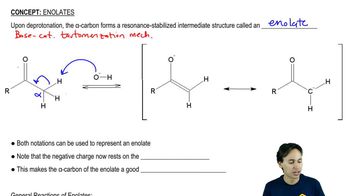
Formation of Enolates

Secondary Haloalkanes

Secondary haloalkanes are compounds where the carbon atom bonded to the halogen is also attached to two other carbon atoms. These structures can undergo nucleophilic substitution via both SN1 and SN2 mechanisms, but the presence of steric hindrance often favors the SN2 pathway, which is relevant when reacting with strong nucleophiles like sodium ethanethiolate.
Recommended video:
1:24
Secondary Protein Structure Example 2