Under acid catalysis, tetrahydrofurfuryl alcohol reacts to give surprisingly good yields of dihydropyran. Propose a mechanism to explain this useful synthesis.
Verified step by step guidance
1
Step 1: Protonation of the hydroxyl group - Under acidic conditions, the hydroxyl group (-OH) of tetrahydrofurfuryl alcohol is protonated by H⁺, forming a positively charged oxonium ion. This step increases the electrophilicity of the oxygen atom and prepares the molecule for subsequent reactions.
Step 2: Formation of a carbocation - The protonated hydroxyl group undergoes elimination of water (H₂O), leading to the formation of a carbocation at the carbon adjacent to the oxygen atom. This carbocation is stabilized by resonance with the oxygen atom in the tetrahydrofuran ring.
Step 3: Intramolecular nucleophilic attack - The oxygen atom in the tetrahydrofuran ring acts as a nucleophile and attacks the carbocation, forming a new bond between the oxygen and the carbocation carbon. This step results in the formation of a six-membered ring intermediate.
Step 4: Deprotonation to form the double bond - A proton is removed from the intermediate, leading to the formation of a double bond in the six-membered ring. This step completes the synthesis of dihydropyran.
Step 5: Final product - The reaction yields dihydropyran, a six-membered ring containing an oxygen atom and a double bond, as the final product.
Verified video answer for a similar problem:
This video solution was recommended by our tutors as helpful for the problem above
Video duration:
4m
Play a video:
0 Comments
Key Concepts
Here are the essential concepts you must grasp in order to answer the question correctly.
Acid Catalysis
Acid catalysis involves the acceleration of a chemical reaction by the presence of an acid, which donates protons (H+) to the reactants. This process can enhance the electrophilicity of certain functional groups, making them more reactive. In the context of organic reactions, acids can facilitate the formation of carbocations, which are key intermediates in many mechanisms, including the conversion of tetrahydrofurfuryl alcohol to dihydropyran.
The formation of dihydropyran from tetrahydrofurfuryl alcohol typically involves a series of steps including protonation, nucleophilic attack, and dehydration. Initially, the alcohol is protonated to form a more reactive carbocation. This carbocation can then undergo intramolecular nucleophilic attack by an alcohol group, leading to the formation of a cyclic ether, followed by loss of water to yield dihydropyran.
Carbocation stability is a crucial concept in organic chemistry, as the stability of these positively charged intermediates influences reaction pathways. Tertiary carbocations are more stable than secondary or primary ones due to hyperconjugation and inductive effects. In the proposed mechanism, the formation of a stable carbocation intermediate from tetrahydrofurfuryl alcohol is essential for the efficient synthesis of dihydropyran under acid catalysis.

 4:44 minutes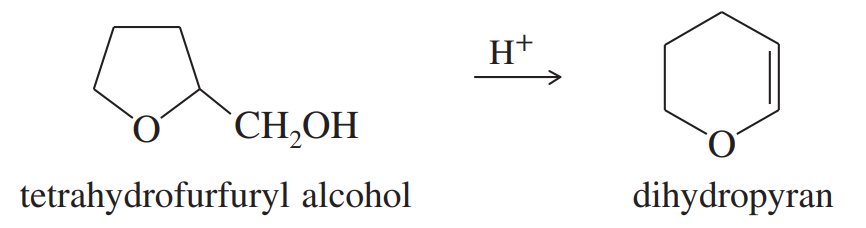
 Verified step by step guidance
 2:50
2:50