Propose mechanisms for the following reactions. d. HINT: Alcohol dehydrations usually go through E1 elimination of the protonated alcohol, with a carbocation intermediate. Rearrangements are common.
Verified step by step guidance
1
Step 1: Protonation of the alcohol group - The reaction begins with the alcohol group being protonated by sulfuric acid (H₂SO₄). This converts the hydroxyl group (-OH) into a better leaving group, forming a protonated alcohol (H₂O⁺).
Step 2: Formation of the carbocation intermediate - The protonated alcohol undergoes elimination of water (H₂O), leaving behind a carbocation intermediate. This carbocation is initially formed at the carbon where the alcohol group was attached.
Step 3: Carbocation rearrangement - Carbocations are prone to rearrangements to form more stable intermediates. In this case, a hydride shift or ring expansion may occur to stabilize the carbocation. Analyze the structure to determine the most stable carbocation configuration.
Step 4: Elimination to form alkenes - The carbocation intermediate undergoes elimination of a proton (H⁺) to form double bonds (alkenes). Depending on the position of the carbocation and the rearrangements, multiple alkenes can be formed as products.
Step 5: Product analysis - The reaction yields a mixture of alkenes, including the ones shown in the image. These products are formed due to the different possible elimination pathways and carbocation rearrangements during the reaction.
Verified video answer for a similar problem:
This video solution was recommended by our tutors as helpful for the problem above
Video duration:
5m
Play a video:
0 Comments
Key Concepts
Here are the essential concepts you must grasp in order to answer the question correctly.
E1 Mechanism
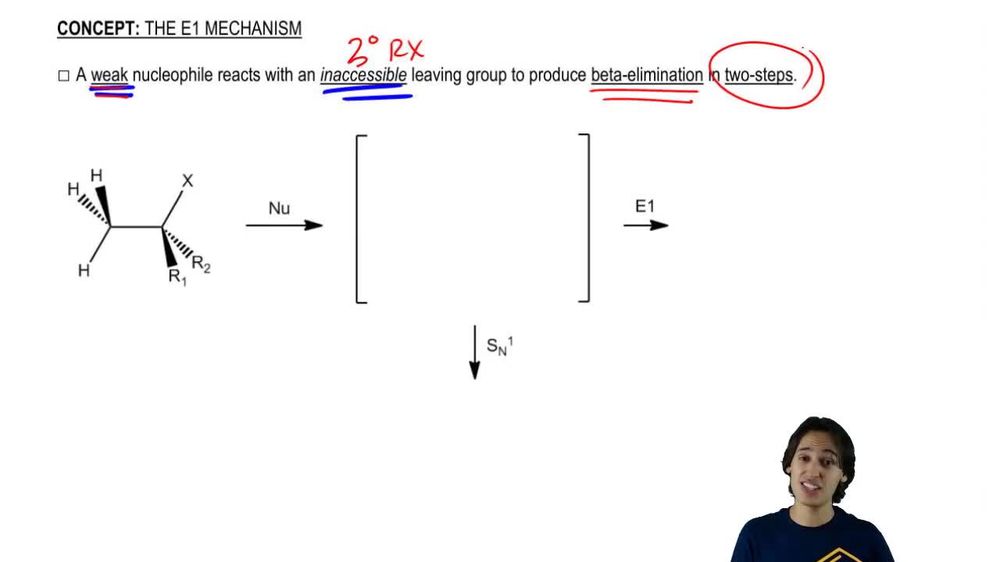
The E1 mechanism is a type of elimination reaction where the rate-determining step involves the formation of a carbocation intermediate after the loss of a leaving group, such as water from a protonated alcohol. This mechanism typically occurs in two steps: first, the alcohol is protonated to form a better leaving group, and then the leaving group departs, forming a carbocation that can lose a proton to form an alkene.
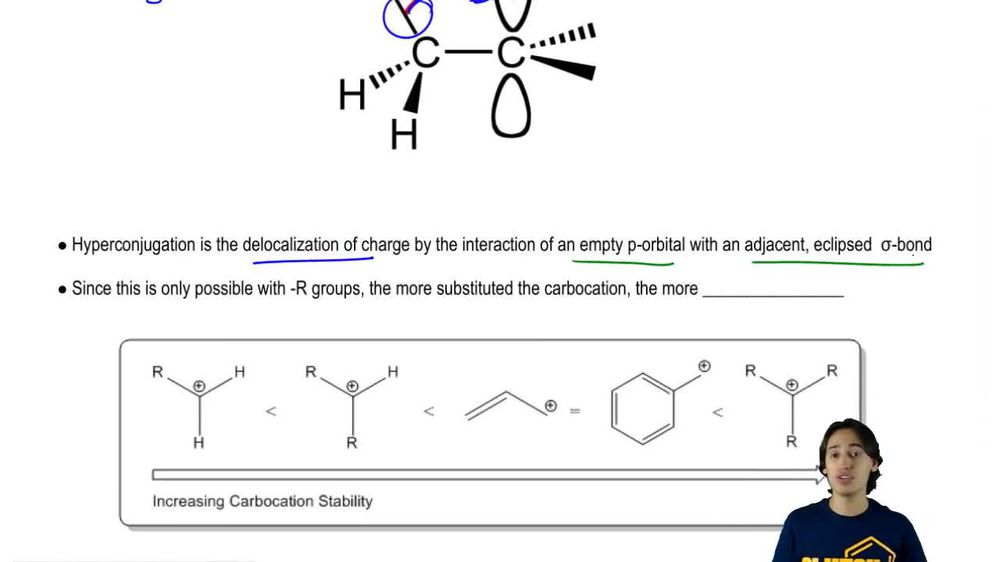
Carbocation stability is crucial in determining the pathway of E1 reactions. Carbocations are positively charged species that can be classified as primary, secondary, or tertiary based on the number of alkyl groups attached to the positively charged carbon. Tertiary carbocations are the most stable due to hyperconjugation and inductive effects, making them more favorable intermediates in elimination reactions.
Rearrangements refer to the structural changes that can occur during the formation of carbocations, often leading to more stable carbocation intermediates. In the context of dehydration reactions, a carbocation may undergo a hydride or alkyl shift to form a more stable carbocation before elimination occurs, resulting in different alkene products. This is a common phenomenon in E1 mechanisms and can lead to a variety of products.

 5:24 minutes
 Verified step by step guidance
 08:09
08:09