Based on Hooke's law, choose the bond in each pair that you expect to vibrate at a higher wavenumber. (e) C=N vs C≡N
Verified step by step guidance
1
Understand Hooke's Law in the context of molecular vibrations: Hooke's Law relates the vibrational frequency of a bond to the force constant (k) and the reduced mass (μ) of the atoms involved. The formula is given by: , where v is the vibrational frequency.
Identify the bonds in question: We have a C=N bond (a double bond) and a C≡N bond (a triple bond).
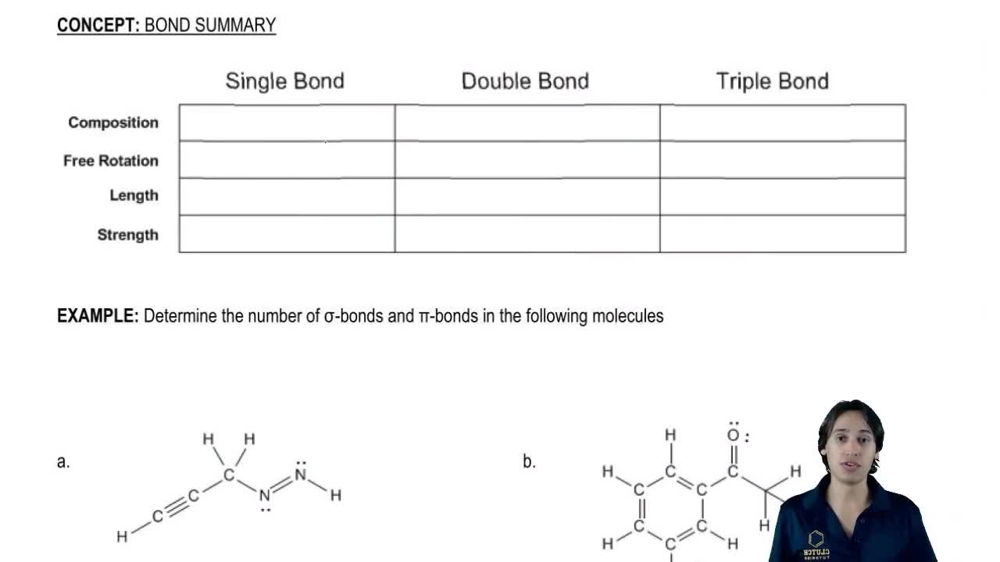
Consider the force constant (k): Triple bonds generally have a higher force constant than double bonds because they are stronger and stiffer. This means that the C≡N bond will have a higher force constant compared to the C=N bond.
Evaluate the reduced mass (μ): The reduced mass is calculated using the formula , where m1 and m2 are the masses of the atoms involved. Since both bonds involve the same atoms (carbon and nitrogen), the reduced mass will be the same for both bonds.
Determine which bond vibrates at a higher wavenumber: Since the C≡N bond has a higher force constant and the same reduced mass as the C=N bond, it will vibrate at a higher wavenumber according to Hooke's Law.
Verified video answer for a similar problem:
This video solution was recommended by our tutors as helpful for the problem above
Video duration:
3m
Play a video:
0 Comments
Key Concepts
Here are the essential concepts you must grasp in order to answer the question correctly.
Hooke's Law in Vibrational Spectroscopy
Hooke's Law relates the vibrational frequency of a bond to the bond strength and the masses of the atoms involved. In vibrational spectroscopy, stronger bonds and lighter atoms result in higher vibrational frequencies, which correspond to higher wavenumbers in IR spectra.
Bond order refers to the number of chemical bonds between a pair of atoms. A higher bond order typically indicates a stronger bond. For example, a triple bond (C≡N) is stronger than a double bond (C=N), leading to higher vibrational frequencies and wavenumbers.
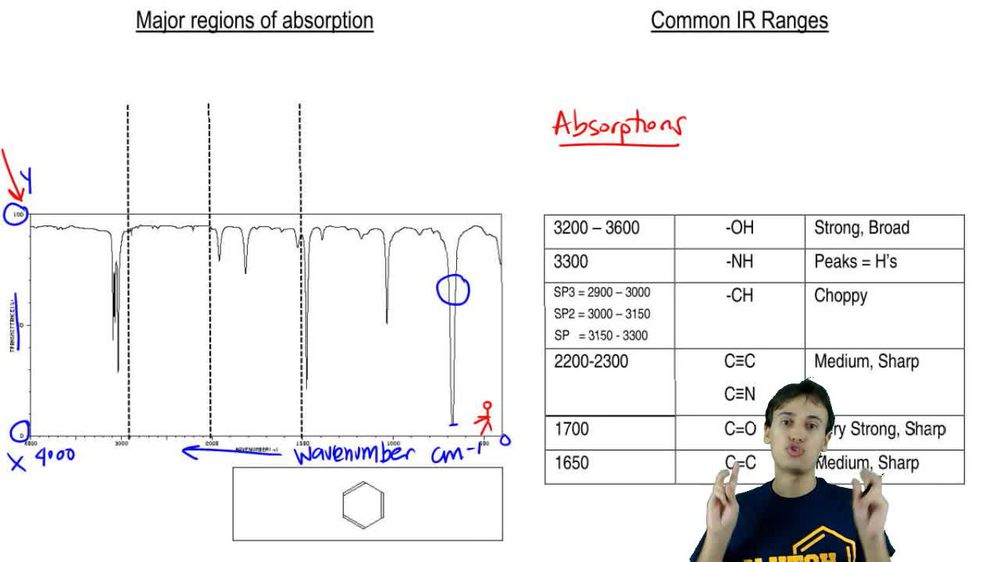
Wavenumber is a measure of frequency used in infrared spectroscopy, expressed in reciprocal centimeters (cm⁻¹). It indicates the energy of molecular vibrations; higher wavenumbers correspond to higher energy vibrations, often seen in stronger bonds like triple bonds compared to double bonds.

 3:23 minutes
 Verified step by step guidance
 1:39
1:39