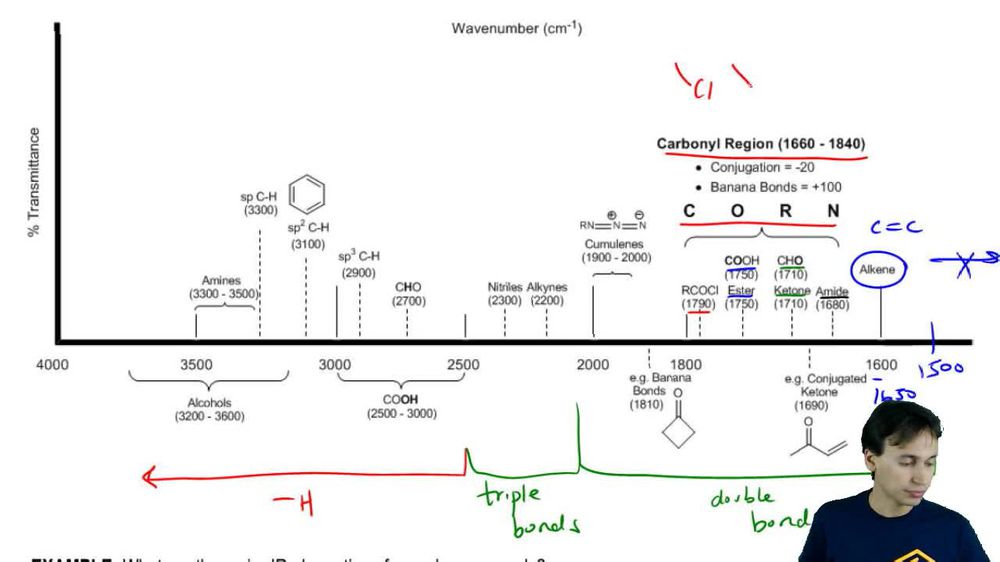
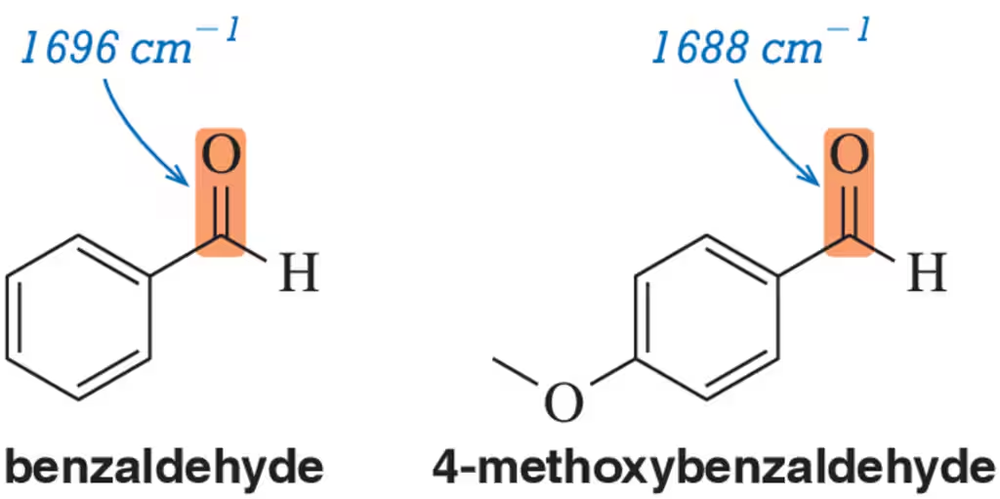
Justify the carbonyl stretching frequencies indicated for benzaldehyde and 4-methoxybenzaldehyde.
Verified step by step guidance
1
Identify the functional groups present in benzaldehyde and 4-methoxybenzaldehyde. Benzaldehyde contains a carbonyl group (C=O) attached to a benzene ring, while 4-methoxybenzaldehyde has a methoxy group (OCH₃) at the para position relative to the carbonyl group.
Understand the concept of electronic effects in aromatic compounds. Substituents on a benzene ring can influence the electron density of the ring and adjacent functional groups through resonance and inductive effects.
Analyze the effect of the methoxy group in 4-methoxybenzaldehyde. The methoxy group is an electron-donating group through resonance, which increases the electron density on the benzene ring and can affect the carbonyl group.
Consider how increased electron density affects the carbonyl stretching frequency. In general, increased electron density on the carbonyl group can lead to a decrease in the carbonyl stretching frequency in IR spectroscopy, as the bond becomes less polar and weaker.
Compare the carbonyl stretching frequencies of benzaldehyde and 4-methoxybenzaldehyde. Due to the electron-donating effect of the methoxy group, the carbonyl stretching frequency in 4-methoxybenzaldehyde is expected to be lower than that in benzaldehyde.
Verified video answer for a similar problem:
This video solution was recommended by our tutors as helpful for the problem above
Play a video:
0 Comments
Key Concepts
Here are the essential concepts you must grasp in order to answer the question correctly.
IR Spectroscopy
Infrared (IR) spectroscopy is a technique used to identify and study chemical substances based on their absorption of infrared light. Molecules absorb specific frequencies that correspond to the vibrations of their bonds, providing a fingerprint that can be used to identify functional groups, such as carbonyls, within a compound.
The carbonyl stretching frequency in IR spectroscopy refers to the specific range of wavenumbers where the C=O bond absorbs infrared light, typically around 1700 cm⁻¹. This frequency can be influenced by the electronic environment around the carbonyl group, such as the presence of electron-donating or electron-withdrawing substituents.
Substituents on a benzene ring can affect the electronic distribution across the ring, influencing the properties of attached functional groups. Electron-donating groups, like methoxy, can increase electron density, potentially lowering the carbonyl stretching frequency, while electron-withdrawing groups can have the opposite effect, raising the frequency.

 Verified step by step guidance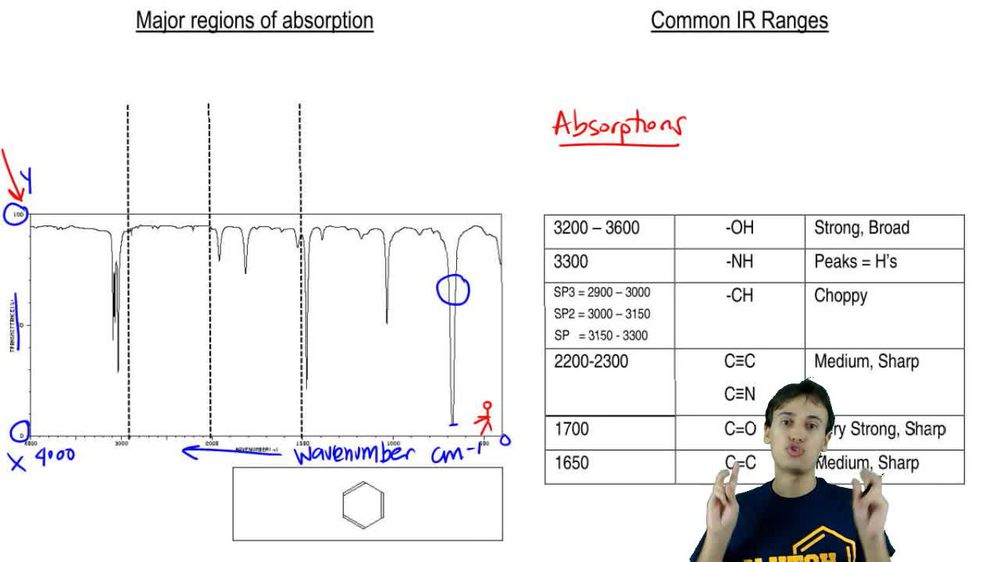
 16:04
16:04