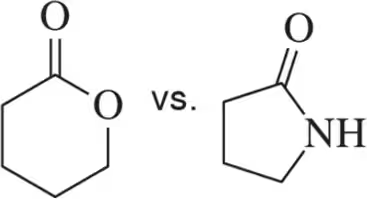
For each pair, choose the molecule that you expect to have the highest wavenumber for its C=O stretch. (d)
Verified step by step guidance
1
Understand that the C=O stretch in infrared spectroscopy is influenced by factors such as bond strength and the surrounding chemical environment. A stronger bond typically results in a higher wavenumber.
Consider the electronic effects on the carbonyl group. Electron-withdrawing groups can increase the bond strength of the C=O bond, leading to a higher wavenumber.
Evaluate the resonance effects. If a molecule has resonance structures that delocalize the electrons away from the carbonyl group, this can weaken the C=O bond and lower the wavenumber.
Assess the steric effects. Bulky groups near the carbonyl can affect the bond angle and length, potentially influencing the wavenumber.
Compare the molecules in the pair based on these factors to determine which one has the stronger C=O bond and thus the higher wavenumber for its C=O stretch.
Verified video answer for a similar problem:
This video solution was recommended by our tutors as helpful for the problem above
Play a video:
0 Comments
Key Concepts
Here are the essential concepts you must grasp in order to answer the question correctly.
Infrared Spectroscopy
Infrared spectroscopy is a technique used to identify functional groups in molecules by measuring the absorption of infrared light, which causes molecular vibrations. The C=O stretch is a common feature in IR spectra, typically appearing around 1700 cm⁻¹. The exact position can vary based on molecular environment and bonding.
Wavenumber, measured in cm⁻¹, is inversely related to wavelength and directly related to the energy of the bond vibration. A higher wavenumber indicates a stronger bond, as more energy is required to stretch it. In the context of C=O bonds, factors like resonance, inductive effects, and hybridization can influence bond strength and thus the wavenumber.
Resonance and inductive effects can alter the electron density around a C=O bond, affecting its strength and the corresponding IR wavenumber. Resonance can delocalize electrons, often weakening the bond and lowering the wavenumber. Inductive effects, from electronegative atoms or groups, can increase electron withdrawal, strengthening the bond and increasing the wavenumber.

 Verified step by step guidance
 2:56
2:56