Which has i. the greater density: heptane or octane? j. the higher boiling point: isopentyl alcohol or isopentylamine? k. the higher boiling point: hexylamine or dipropylamine?
Verified step by step guidance
1
To determine the greater density between heptane and octane, consider that density is influenced by molecular weight and molecular structure. Octane (C8H18) has a higher molecular weight than heptane (C7H16), and both are nonpolar hydrocarbons with similar structures. Therefore, octane is expected to have a slightly greater density due to its higher molecular weight.
To compare the boiling points of isopentyl alcohol and isopentylamine, analyze their intermolecular forces. Isopentyl alcohol (C5H12O) contains a hydroxyl (-OH) group, which allows for strong hydrogen bonding. Isopentylamine (C5H13N) contains an amine (-NH2) group, which also allows for hydrogen bonding but is generally weaker than the hydrogen bonding in alcohols. Thus, isopentyl alcohol is expected to have a higher boiling point.
To compare the boiling points of hexylamine and dipropylamine, consider their molecular structures and intermolecular forces. Hexylamine (C6H15N) is a primary amine with a straight-chain structure, while dipropylamine (C6H15N) is a secondary amine with two propyl groups attached to the nitrogen. Primary amines generally have stronger hydrogen bonding than secondary amines due to the availability of more hydrogen atoms for bonding. Therefore, hexylamine is expected to have a higher boiling point.
For each comparison, remember that boiling point trends are primarily influenced by intermolecular forces (e.g., hydrogen bonding, dipole-dipole interactions, and London dispersion forces), while density trends are influenced by molecular weight and compactness of the structure.
To confirm these predictions, you could look up experimental data for the boiling points and densities of the compounds in question, as these properties are measurable and can vary slightly depending on conditions.
Verified video answer for a similar problem:
This video solution was recommended by our tutors as helpful for the problem above
Video duration:
5m
Play a video:
0 Comments
Key Concepts
Here are the essential concepts you must grasp in order to answer the question correctly.
Density of Hydrocarbons
Density in hydrocarbons is influenced by molecular weight and structure. Generally, as the carbon chain length increases, the density also increases due to a greater number of atoms contributing to mass. Heptane (C7H16) and octane (C8H18) are both alkanes, but octane, having a longer carbon chain, typically exhibits a higher density than heptane.
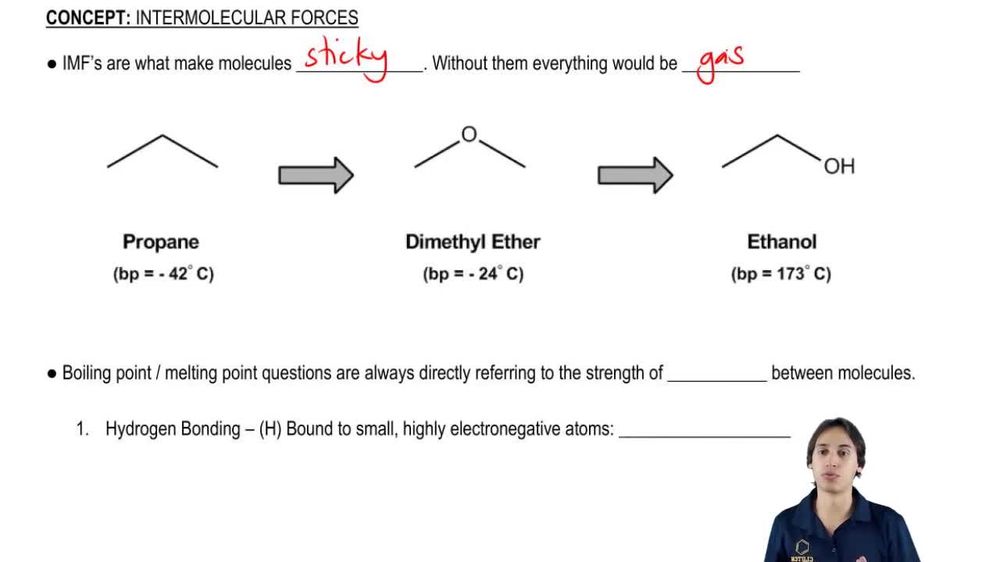
The boiling point of a substance is determined by the strength of its intermolecular forces. Alcohols, like isopentyl alcohol, have hydrogen bonding due to the -OH group, which generally raises their boiling points compared to amines, such as isopentylamine, which have weaker dipole-dipole interactions. Thus, understanding these forces is crucial for comparing boiling points.
How IMFs are related to melting and boiling points.
Comparison of Amines
When comparing boiling points of amines, factors such as molecular weight and the presence of branching play significant roles. Hexylamine and dipropylamine differ in structure; dipropylamine has a branched configuration, which can lead to lower boiling points due to reduced surface area for intermolecular interactions. Analyzing these structural differences helps predict their boiling point behavior.

 5:41 minutes
 Verified step by step guidance
 04:52
04:52