What is the smallest straight-chain alkane that is a liquid at room temperature (which is about 25 °C)?
Verified step by step guidance
1
Understand the problem: We are tasked with identifying the smallest straight-chain alkane that exists as a liquid at room temperature (approximately 25 °C). Alkanes are hydrocarbons with the general formula CnH2n+2, and their physical state depends on molecular size and intermolecular forces.
Recall the trend: The physical state of alkanes (gas, liquid, or solid) at room temperature depends on their molecular weight and boiling point. Smaller alkanes (with fewer carbon atoms) tend to be gases, while larger alkanes are liquids or solids due to stronger London dispersion forces.
Identify the boiling point range: For an alkane to be a liquid at room temperature, its boiling point must be between 25 °C and 100 °C. Alkanes with boiling points below 25 °C are gases, and those above 100 °C are typically liquids or solids.
Consult boiling point data: Look up the boiling points of straight-chain alkanes (e.g., methane, ethane, propane, butane, pentane, hexane, etc.) to determine the smallest alkane whose boiling point falls within the liquid range at room temperature.
Conclude the smallest alkane: Based on the boiling point data, identify the straight-chain alkane with the lowest molecular weight that meets the criteria of being a liquid at room temperature.
Verified video answer for a similar problem:
This video solution was recommended by our tutors as helpful for the problem above
Video duration:
4m
Play a video:
0 Comments
Key Concepts
Here are the essential concepts you must grasp in order to answer the question correctly.
Alkanes
Alkanes are saturated hydrocarbons consisting only of carbon and hydrogen atoms, connected by single bonds. They follow the general formula CnH2n+2, where 'n' is the number of carbon atoms. Alkanes can be straight-chain or branched, and their physical properties, such as boiling and melting points, vary with molecular size.
The boiling point of a substance is the temperature at which its vapor pressure equals the external pressure, causing it to change from liquid to gas. For alkanes, the boiling point increases with molecular weight due to greater van der Waals forces. Understanding boiling points helps determine the state of an alkane at a given temperature.
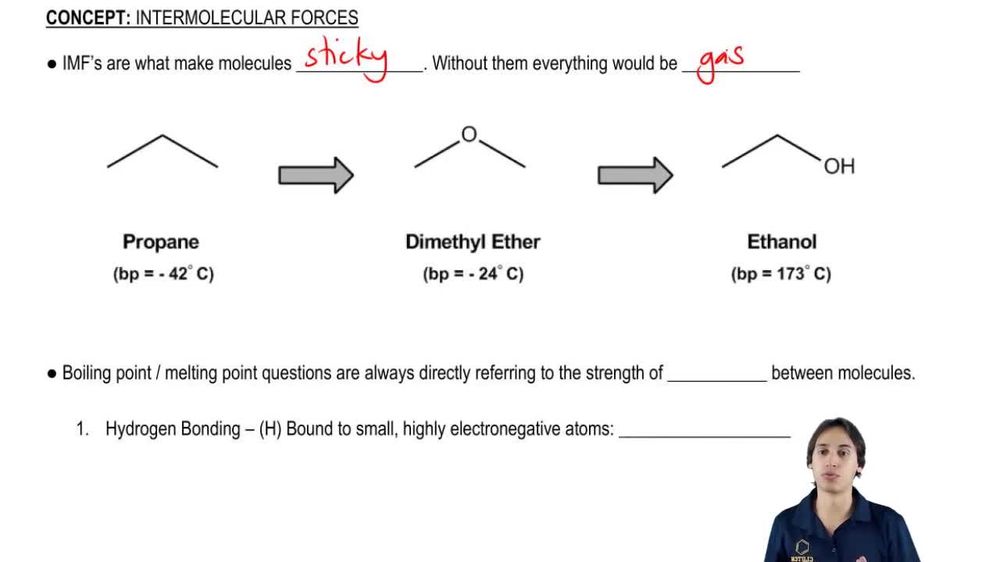
How IMFs are related to melting and boiling points.
State of Matter at Room Temperature
Room temperature, typically around 25 °C, is a standard reference point for assessing the physical state of substances. Alkanes with fewer than five carbon atoms (like methane and ethane) are gases at this temperature, while those with five or more carbons are liquids. Identifying the smallest alkane that is liquid at room temperature requires knowledge of these state changes.

 4:31 minutes
 Verified step by step guidance
 02:47
02:47