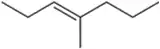
Predict the product(s) that would result when the alkenes are allowed to react under the following conditions: (iii) Br2, H2O ; (iv) Cl2, CH3OH (f)
Verified step by step guidance
1
Step 1: Analyze the structure of the given alkene. The molecule contains a double bond, which is the reactive site for electrophilic addition reactions. The double bond is located between two carbon atoms in the middle of the structure.
Step 2: For reaction (iii) with Br₂ and H₂O, the mechanism involves the formation of a bromonium ion intermediate. Bromine (Br₂) adds to the double bond, creating a cyclic bromonium ion. Water (H₂O) then attacks the more substituted carbon of the bromonium ion, leading to the formation of a bromohydrin product.
Step 3: Predict the regioselectivity for reaction (iii). The water molecule will preferentially attack the more substituted carbon due to the stability of the carbocation-like transition state. This results in the hydroxyl group (-OH) attaching to the more substituted carbon and the bromine atom attaching to the less substituted carbon.
Step 4: For reaction (iv) with Cl₂ and CH₃OH, the mechanism is similar to reaction (iii). Chlorine (Cl₂) adds to the double bond, forming a cyclic chloronium ion. Methanol (CH₃OH) then attacks the more substituted carbon of the chloronium ion, leading to the formation of a chloromethoxy product.
Step 5: Predict the regioselectivity for reaction (iv). Methanol will attack the more substituted carbon, resulting in the methoxy group (-OCH₃) attaching to the more substituted carbon and the chlorine atom attaching to the less substituted carbon.
Verified video answer for a similar problem:
This video solution was recommended by our tutors as helpful for the problem above
Play a video:
0 Comments
Key Concepts
Here are the essential concepts you must grasp in order to answer the question correctly.
Electrophilic Addition Reactions
Electrophilic addition reactions are a fundamental type of reaction for alkenes, where an electrophile reacts with the double bond, resulting in the formation of a more stable product. In the presence of halogens like Br₂ or Cl₂, the alkene undergoes addition across the double bond, leading to the formation of vicinal dihalides. Understanding the mechanism of these reactions is crucial for predicting the products formed under different conditions.
Regioselectivity refers to the preference of a chemical reaction to yield one structural isomer over others when multiple products are possible. In the case of reactions involving alkenes and halogens, the Markovnikov rule often applies, where the more substituted carbon atom of the alkene receives the electrophile. This concept is essential for predicting the major product when alkenes react with reagents like Br₂ in the presence of water or methanol.
The choice of solvent can significantly influence the outcome of a chemical reaction. In the given question, the presence of water (H₂O) or methanol (CH₃OH) as solvents can lead to different reaction pathways. For example, in the presence of water, a bromohydrin is formed, while methanol can lead to the formation of an ether. Understanding how solvents interact with reactants is crucial for predicting the products of organic reactions.

 Verified step by step guidance
 05:39
05:39