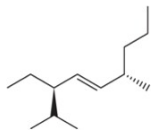
Predict the product(s) that would result when the alkenes are allowed to react under the following conditions: (iii) Br2, H2O ; (iv) Cl2, CH3OH; (l)
Verified step by step guidance
1
Step 1: Analyze the structure of the given alkene. The molecule contains a double bond, which is the reactive site for electrophilic addition reactions. Identify the position of the double bond and any stereochemistry or substituents that may influence the reaction.
Step 2: For reaction (iii) with Br₂ and H₂O, understand that this is a halohydrin formation reaction. Bromine (Br₂) adds to the double bond, forming a bromonium ion intermediate. Water (H₂O) then attacks the more substituted carbon of the bromonium ion, leading to the formation of a halohydrin with anti stereochemistry.
Step 3: For reaction (iv) with Cl₂ and CH₃OH, recognize that this is a similar reaction to halohydrin formation, but methanol (CH₃OH) acts as the nucleophile instead of water. Chlorine (Cl₂) adds to the double bond, forming a chloronium ion intermediate. Methanol attacks the more substituted carbon of the chloronium ion, resulting in the formation of an ether with anti stereochemistry.
Step 4: Consider regioselectivity and stereochemistry for both reactions. The nucleophile (H₂O or CH₃OH) will attack the more substituted carbon of the intermediate due to stability considerations, and the addition will occur with anti stereochemistry.
Step 5: Predict the products for each reaction based on the mechanism. For (iii), the product will be a bromohydrin with anti stereochemistry. For (iv), the product will be a chloroether with anti stereochemistry. Ensure that the stereochemistry of the substituents on the original molecule is preserved in the final products.
Verified video answer for a similar problem:
This video solution was recommended by our tutors as helpful for the problem above
Play a video:
0 Comments
Key Concepts
Here are the essential concepts you must grasp in order to answer the question correctly.
Electrophilic Addition Reactions
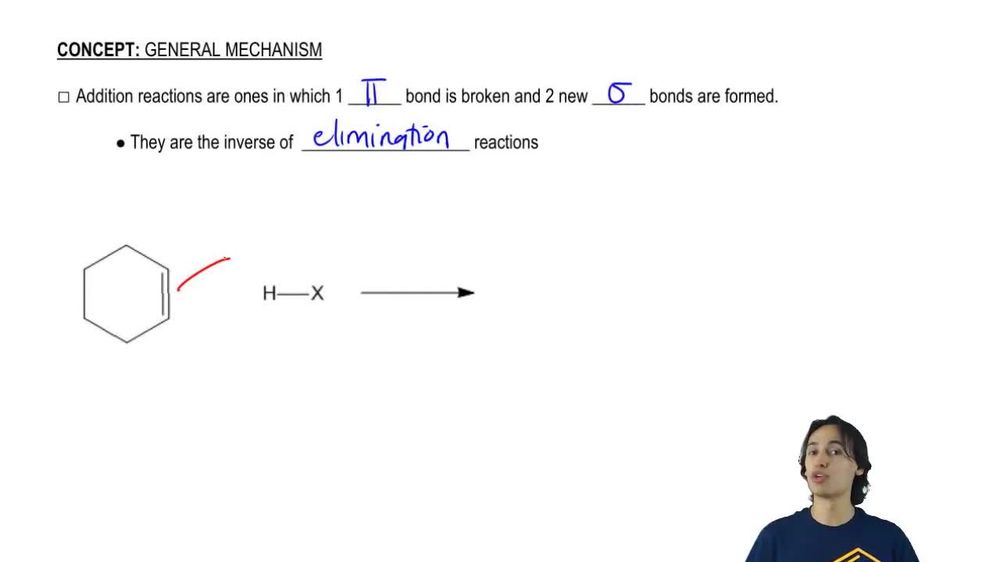
Electrophilic addition reactions are a fundamental type of reaction for alkenes, where an electrophile reacts with the double bond of the alkene. This process typically involves the formation of a carbocation intermediate, which can lead to the addition of various nucleophiles. Understanding this mechanism is crucial for predicting the products formed when alkenes react with halogens or other electrophiles.
Regioselectivity refers to the preference of a chemical reaction to yield one structural isomer over others when multiple products are possible. In the context of alkene reactions, the Markovnikov rule often applies, indicating that the more substituted carbocation will be formed preferentially. This concept is essential for predicting the major product when alkenes react with halogens in the presence of solvents like water or alcohol.
The choice of solvent can significantly influence the outcome of a chemical reaction, particularly in electrophilic addition reactions. For example, using water as a solvent can lead to the formation of alcohols through hydration, while using methanol can result in ether formation. Understanding how solvents interact with reactants helps in predicting the products of reactions involving alkenes and halogens.