Draw a condensed structure and a skeletal structure for each of the following: a. sec-butyl tert-butyl ether b. isoheptyl alcohol
Verified step by step guidance
1
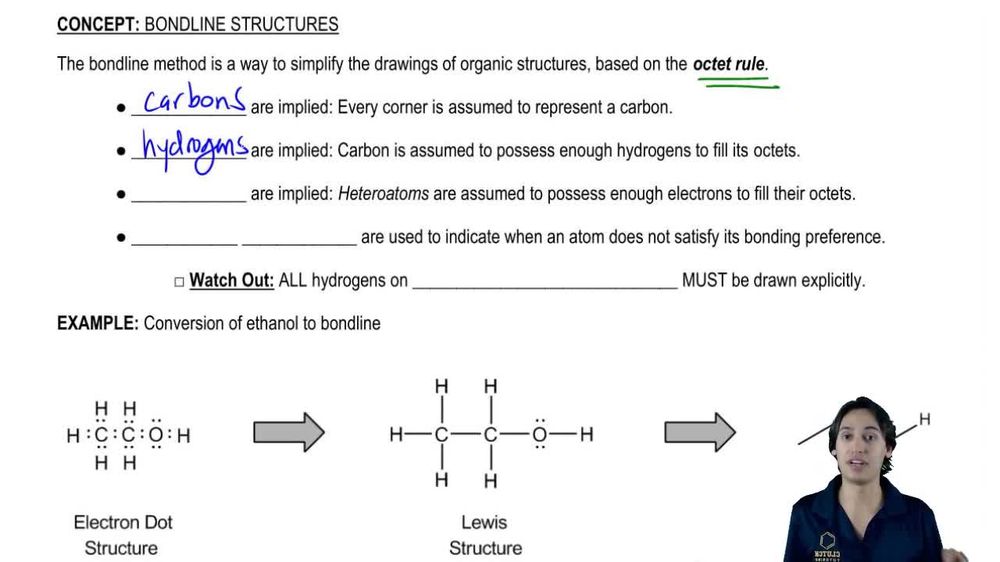
Step 1: Understand the problem. You are tasked with drawing two types of structures (condensed and skeletal) for two compounds: (a) sec-butyl tert-butyl ether and (b) isoheptyl alcohol. Condensed structures show all atoms and their connectivity in a compact form, while skeletal structures represent bonds between carbon atoms as lines, omitting hydrogen atoms bonded to carbons.
Step 2: For (a) sec-butyl tert-butyl ether, identify the functional groups and substituents. The compound is an ether, meaning it has an oxygen atom bonded to two alkyl groups. The 'sec-butyl' group is a four-carbon chain with a secondary carbon attached to the oxygen, and the 'tert-butyl' group is a three-carbon chain attached to a central carbon bonded to the oxygen.
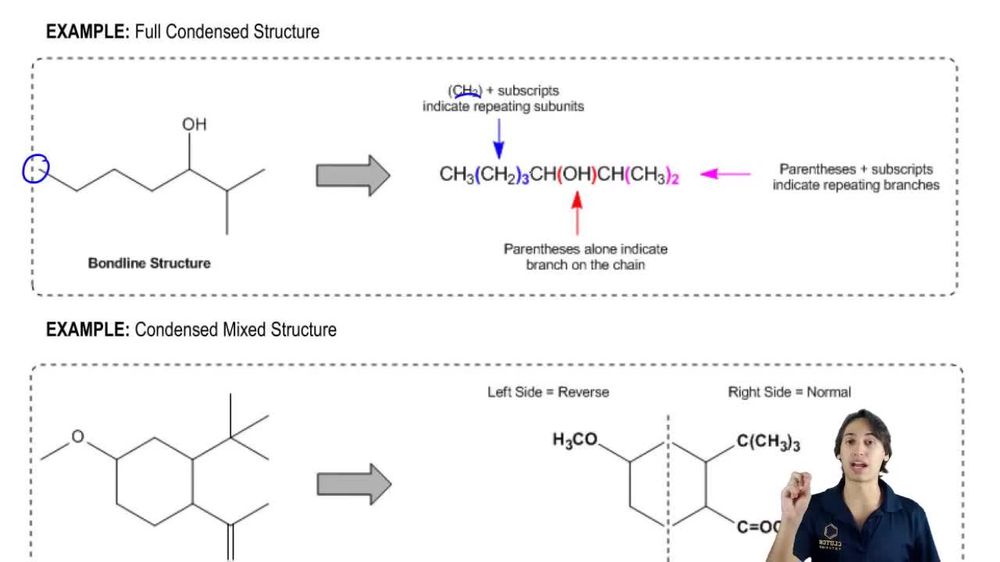
Step 3: Draw the condensed structure for (a). Start with the oxygen atom (O) in the center. Attach the sec-butyl group on one side, which can be written as CH3CH(CH3)CH2-, and the tert-butyl group on the other side, which can be written as (CH3)3C-. Combine these to form the condensed structure.
Step 4: Draw the skeletal structure for (a). Represent the sec-butyl group as a zigzag line with a branch at the second carbon, and the tert-butyl group as a central carbon with three branches. Connect these groups via the oxygen atom.
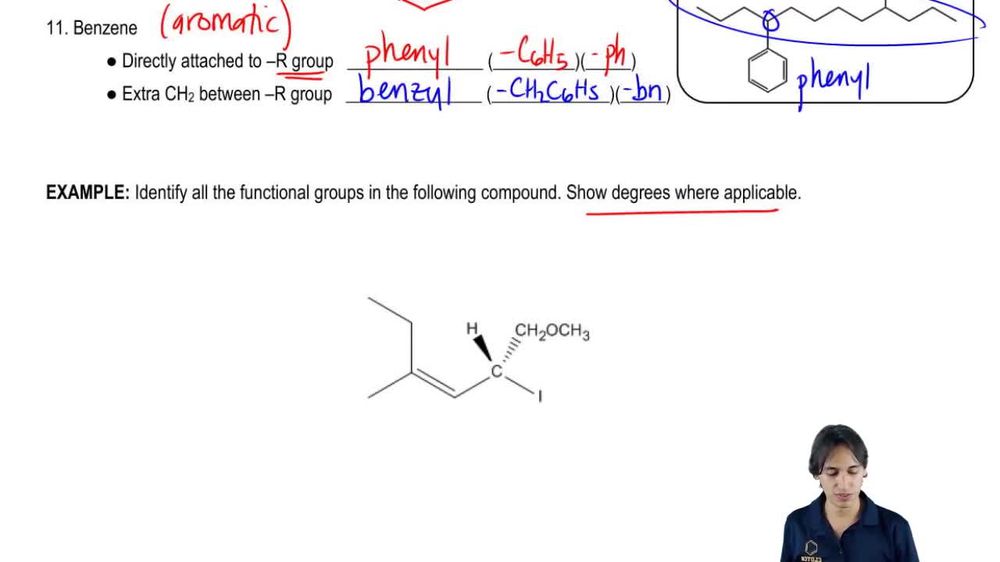
Step 5: For (b) isoheptyl alcohol, identify the structure. 'Isoheptyl' refers to a seven-carbon chain with a branch at the second carbon, and 'alcohol' indicates the presence of an -OH group. Draw the condensed structure by writing the branched chain (CH3CH(CH3)CH2CH2CH2CH2-) and attaching the -OH group at the end. For the skeletal structure, represent the carbon chain as a zigzag line with a branch at the second carbon and an -OH group at the terminal carbon.
Verified video answer for a similar problem:
This video solution was recommended by our tutors as helpful for the problem above
Video duration:
4m
Play a video:
0 Comments
Key Concepts
Here are the essential concepts you must grasp in order to answer the question correctly.
Condensed Structure
A condensed structure is a simplified representation of a molecule that shows the arrangement of atoms and their connectivity without depicting all the bonds explicitly. In this format, groups of atoms are often grouped together, and hydrogen atoms attached to carbons are usually omitted for clarity. This type of structure is useful for quickly conveying the molecular formula and connectivity in a compact form.
A skeletal structure, also known as a line-angle structure, is a representation of organic molecules where carbon atoms are represented by vertices or ends of lines, and hydrogen atoms are implied. This format emphasizes the carbon backbone and functional groups, making it easier to visualize the overall shape and connectivity of the molecule. It is particularly useful for larger molecules where a full structural formula would be cumbersome.
Functional groups are specific groups of atoms within molecules that are responsible for the characteristic chemical reactions of those molecules. In the context of ethers and alcohols, the ether functional group (-O-) and the hydroxyl group (-OH) are crucial for understanding the properties and reactivity of sec-butyl tert-butyl ether and isoheptyl alcohol. Recognizing these groups helps in predicting the behavior of the compounds in chemical reactions.

 4:54 minutes
 Verified step by step guidance
 06:06
06:06