
Ch. 5 - Alkenes: Structure, Nomenclature, and an Introduction to Reactivity • Thermodynamics and Kinetics
Bruice - Organic Chemistry 8th Edition
Bruice8th EditionOrganic ChemistryISBN: 9780135213711Not the one you use?Change textbook
Chapter 6, Problem 38

Which of the following parameters would be different for a reaction carried out in the presence of a catalyst compared with the same reaction carried out in the absence of a catalyst?
G°, ∆H, Ea, ∆S, ∆H°, Keq, ∆G, ∆S°, k

Verified step by step guidance
1
Step 1: Understand the role of a catalyst in a chemical reaction. A catalyst speeds up the reaction by providing an alternative pathway with a lower activation energy (Ea), but it does not alter the thermodynamic properties of the reaction such as ∆G°, ∆H°, ∆S°, or Keq.
Step 2: Identify the parameters that are directly affected by the presence of a catalyst. The activation energy (Ea) and the Gibbs free energy of activation (∆G‡) are reduced because the catalyst lowers the energy barrier for the reaction.
Step 3: Recognize that the enthalpy of activation (∆H‡) and entropy of activation (∆S‡) may also change because the catalyst modifies the transition state of the reaction, altering the energy and molecular arrangement required to reach it.
Step 4: Note that thermodynamic parameters such as ∆G°, ∆H°, ∆S°, and the equilibrium constant (Keq) remain unchanged because a catalyst does not affect the overall energy difference between reactants and products or the position of equilibrium.
Step 5: Conclude that the parameters affected by the presence of a catalyst are Ea, ∆G‡, ∆H‡, and ∆S‡, while ∆G°, ∆H°, ∆S°, Keq, and the rate constant (k) are indirectly influenced through the reduction in activation energy, leading to an increased reaction rate.

Verified video answer for a similar problem:

This video solution was recommended by our tutors as helpful for the problem above.
Video duration:
6m
Was this helpful?

Key Concepts

Here are the essential concepts you must grasp in order to answer the question correctly.

Activation Energy (Ea)

Activation energy (Ea) is the minimum energy required for a chemical reaction to occur. A catalyst lowers the activation energy, allowing the reaction to proceed more easily and quickly. This means that while the overall energy change of the reaction remains the same, the presence of a catalyst alters the energy barrier that must be overcome for the reaction to take place.
Recommended video:
3:22
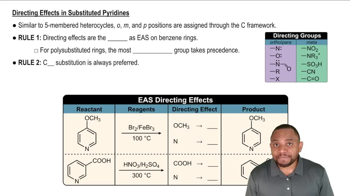
EAS Reactions of Pyridine Concept 3

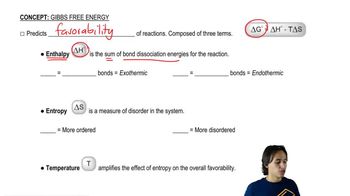
Gibbs Free Energy (∆G°)

Gibbs free energy (∆G°) is a thermodynamic potential that indicates the spontaneity of a reaction at standard conditions. It is not affected by the presence of a catalyst, as catalysts do not change the overall energy difference between reactants and products. Therefore, while catalysts speed up reactions, they do not alter the Gibbs free energy change of the reaction.
Recommended video:
Guided course
05:02
Breaking down the different terms of the Gibbs Free Energy equation.

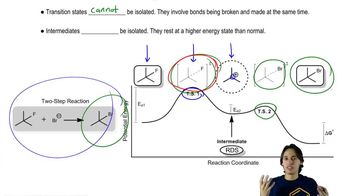
Transition State Theory (∆H‡ and ∆S‡)

Transition state theory describes the high-energy state that occurs during a chemical reaction, characterized by enthalpy (∆H‡) and entropy (∆S‡) changes. A catalyst stabilizes the transition state, which can lower both the enthalpy and entropy of activation, thus facilitating the reaction. This means that while the overall reaction parameters remain unchanged, the activation parameters are significantly affected by the presence of a catalyst.
Recommended video:
Guided course
06:55
Intermediates vs. Transition States