Ch. 17 - Reactions at the Alpha-Carbon
Bruice - Organic Chemistry 8th Edition
Bruice8th EditionOrganic ChemistryISBN: 9780135213711Not the one you use?Change textbook
Chapter 18, Problem 62

Show how the following compound can be synthesized from the given starting material. (Hint: Start with an acetoacetic ester.)

Verified step by step guidance
1
Step 1: Begin with the acetoacetic ester (ethyl acetoacetate) as the starting material. Deprotonate the alpha hydrogen using a strong base such as sodium ethoxide (NaOEt) to form the enolate ion. This step is crucial for enabling nucleophilic attack in subsequent steps.
Step 2: Perform an alkylation reaction by reacting the enolate ion with an alkyl halide, such as 1-bromopentane, to introduce the pentyl group at the alpha position of the acetoacetic ester. This step uses the SN2 mechanism.
Step 3: Hydrolyze the ester group in the acetoacetic ester derivative using aqueous acid (H3O+) to convert it into a beta-keto acid. This step involves ester hydrolysis followed by decarboxylation.
Step 4: Decarboxylate the beta-keto acid by heating it. This removes the carboxyl group as CO2, leaving behind the desired ketone structure with the pentyl group attached.
Step 5: Combine the cyclohexanol starting material with the synthesized ketone. Oxidize cyclohexanol to cyclohexanone using an oxidizing agent such as PCC (pyridinium chlorochromate). Then, perform an aldol condensation between cyclohexanone and the synthesized ketone to form the final compound.

Verified video answer for a similar problem:

This video solution was recommended by our tutors as helpful for the problem above.
Video duration:
2m
Was this helpful?

Key Concepts

Here are the essential concepts you must grasp in order to answer the question correctly.

Acetoacetic Ester Synthesis

Acetoacetic ester synthesis is a method used to create ketones from acetoacetic esters. This reaction involves the enolate ion of the acetoacetic ester reacting with an alkyl halide, followed by hydrolysis and decarboxylation. Understanding this process is crucial for synthesizing complex organic compounds, as it allows for the introduction of various alkyl groups to the carbon skeleton.
Recommended video:
01:28
Synthesis of Amino Acids: Acetamidomalonic Ester Synthesis Example 2

Enolate Chemistry

Enolates are reactive intermediates formed from the deprotonation of carbonyl compounds, such as ketones and esters. They play a key role in nucleophilic addition reactions, allowing for the formation of new carbon-carbon bonds. Mastery of enolate chemistry is essential for understanding how to manipulate starting materials in organic synthesis, particularly in the context of acetoacetic ester reactions.
Recommended video:
Guided course
02:26
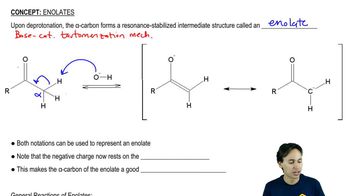
Formation of Enolates

Decarboxylation

Decarboxylation is the process of removing a carboxyl group from a molecule, typically resulting in the release of carbon dioxide. This reaction is often used in organic synthesis to simplify structures and increase the carbon chain length. Recognizing when and how to apply decarboxylation is vital for completing the synthesis of target compounds from acetoacetic esters.
Recommended video:
Guided course
02:32
Predict the correct structure