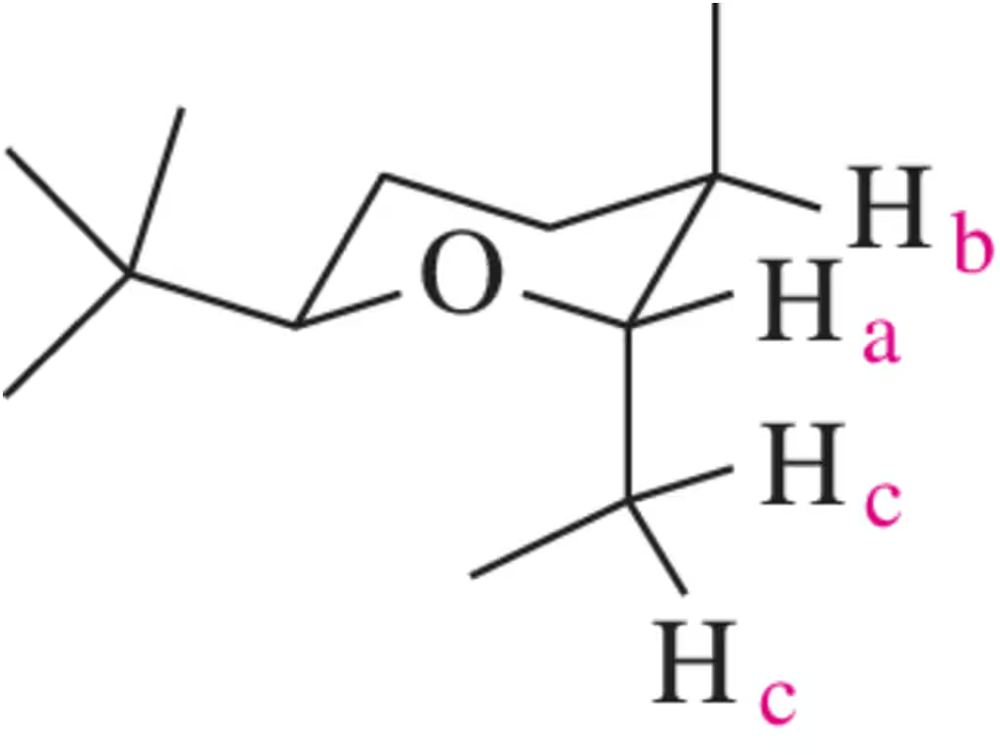
Draw the expected signal for a hydrogen with the following coupling constants. (b) Hₐ : δ 3.34 (Jₐ꜀ = 9 , Jₐ₆ = 4 )
Verified step by step guidance
1
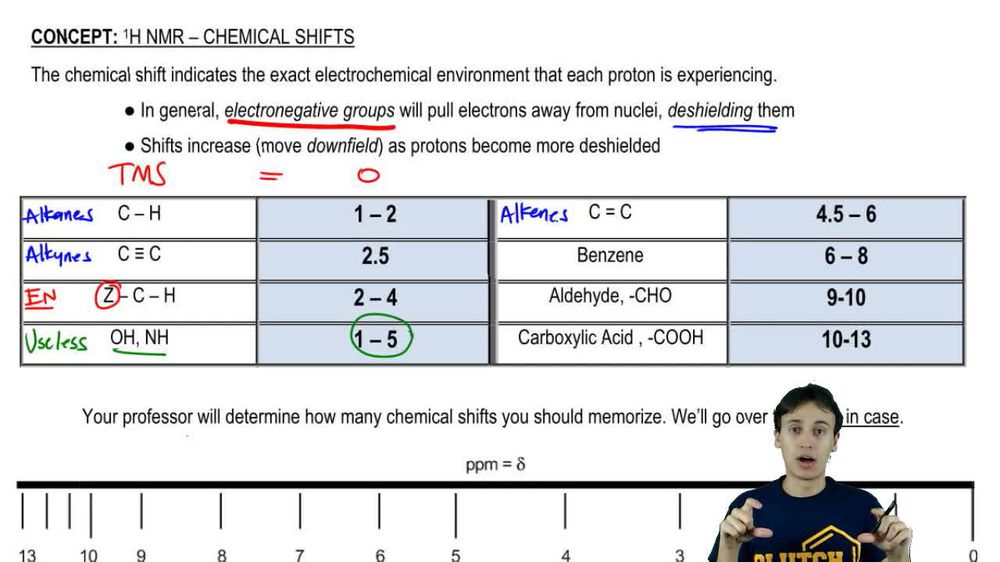
Identify the type of hydrogen environment for Hₐ. The chemical shift (δ) at 3.34 ppm suggests it is likely in a deshielded environment, possibly near an electronegative atom or a π-system.
Determine the splitting pattern using the given coupling constants. The coupling constants Jₐ꜀ = 9 Hz and Jₐ₆ = 4 Hz indicate that Hₐ is coupled to two different sets of hydrogens.
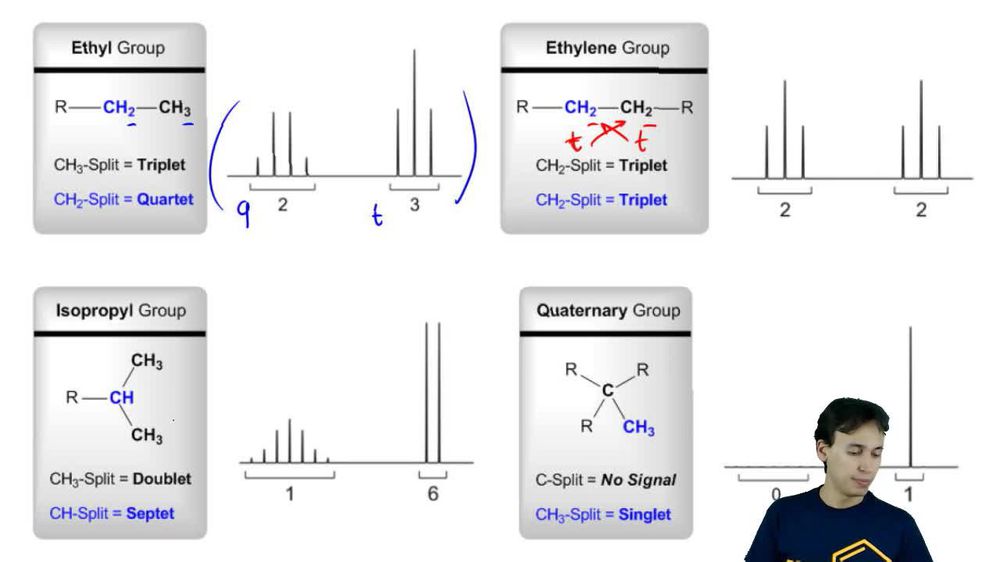
Apply the n+1 rule for each coupling constant to predict the splitting pattern. For Jₐ꜀ = 9 Hz, if Hₐ is coupled to n hydrogens, the splitting will be (n+1). Similarly, apply this for Jₐ₆ = 4 Hz.
Combine the splitting patterns from each coupling to determine the overall multiplicity. The signal will be a doublet of doublets (dd) due to the two different coupling constants.
Sketch the expected NMR signal for Hₐ, showing a doublet of doublets with the larger coupling constant (9 Hz) causing the larger separation and the smaller coupling constant (4 Hz) causing the smaller separation within each doublet.
Verified video answer for a similar problem:
This video solution was recommended by our tutors as helpful for the problem above
Play a video:
0 Comments
Key Concepts
Here are the essential concepts you must grasp in order to answer the question correctly.
Chemical Shift (δ)
Chemical shift (δ) is a measure of the resonance frequency of a nucleus relative to a standard in a magnetic field. It is expressed in parts per million (ppm) and provides information about the electronic environment surrounding the nucleus. In this question, δ 3.34 indicates the position of the hydrogen signal on the NMR spectrum, suggesting the hydrogen is in a relatively deshielded environment.
Coupling constants (J) are a measure of the interaction between nuclear spins and are expressed in hertz (Hz). They provide information about the number of neighboring hydrogens and their spatial relationship. In this question, Jₐ꜀ = 9 Hz and Jₐ₆ = 4 Hz indicate the hydrogen is coupled to two different sets of neighboring hydrogens, leading to a splitting pattern in the NMR signal.
NMR splitting patterns arise from spin-spin coupling between non-equivalent hydrogens. The number of peaks in a splitting pattern is determined by the n+1 rule, where n is the number of neighboring hydrogens. In this case, the hydrogen with coupling constants Jₐ꜀ = 9 Hz and Jₐ₆ = 4 Hz will exhibit a complex splitting pattern, reflecting its interactions with two different sets of neighboring hydrogens.