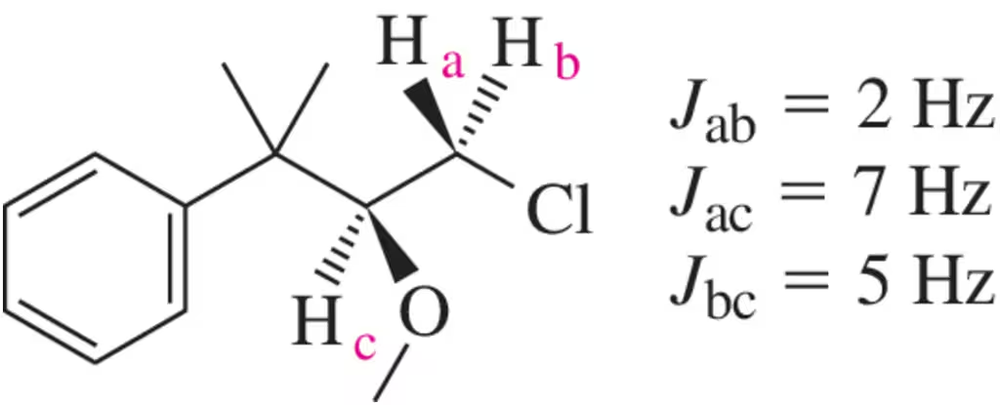
Sketch the signals you would expect to see for Hₐ in the molecule shown. The important coupling constants are given.
Verified step by step guidance
1
Identify the hydrogen atom labeled as Hₐ in the molecular structure. This is the hydrogen for which we need to predict the NMR signals.
Determine the number of neighboring hydrogen atoms (n) that are coupled to Hₐ. This will help in predicting the splitting pattern of the signal.
Use the n+1 rule to predict the splitting pattern of the signal for Hₐ. The n+1 rule states that a hydrogen atom with n neighboring hydrogens will split into n+1 peaks.
Consider the given coupling constants (J values) to determine the spacing between the peaks in the splitting pattern. The coupling constant is the distance between the peaks in Hz.
Sketch the expected NMR signal for Hₐ, showing the correct number of peaks and the spacing between them based on the coupling constants provided.
Verified video answer for a similar problem:
This video solution was recommended by our tutors as helpful for the problem above
Play a video:
0 Comments
Key Concepts
Here are the essential concepts you must grasp in order to answer the question correctly.
NMR Spectroscopy
Nuclear Magnetic Resonance (NMR) spectroscopy is a technique used to determine the structure of organic compounds by analyzing the magnetic properties of atomic nuclei. In NMR, hydrogen atoms (protons) in a molecule produce signals that can be interpreted to reveal information about the chemical environment and connectivity of the atoms.
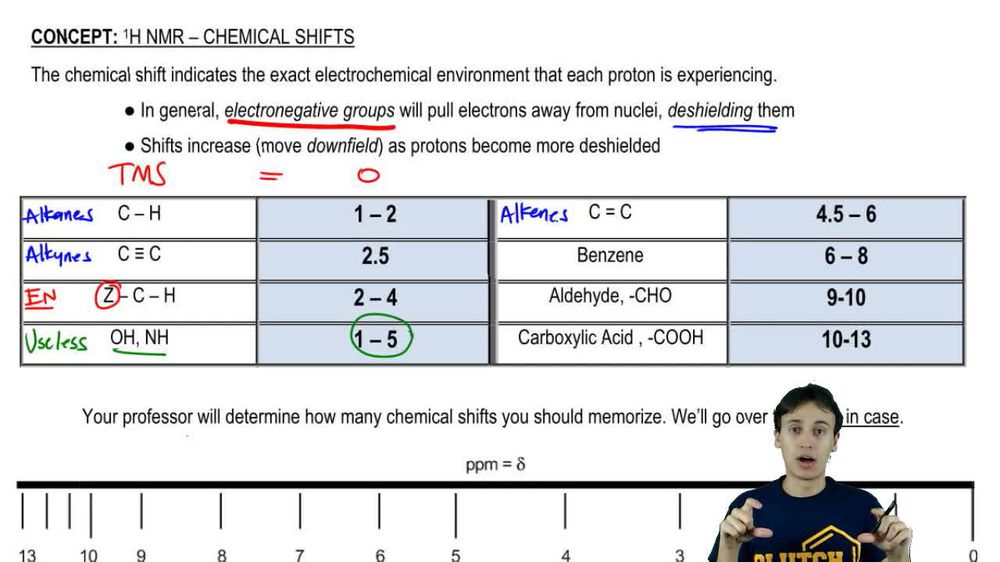
Chemical shift refers to the position of an NMR signal on the spectrum, measured in parts per million (ppm). It indicates the electronic environment surrounding a nucleus, with shifts affected by factors such as electronegativity and hybridization of nearby atoms. Understanding chemical shifts helps predict where a proton signal will appear in the NMR spectrum.
Spin-spin coupling, or J-coupling, occurs when magnetic interactions between neighboring nuclei cause splitting of NMR signals into multiple peaks. The coupling constant (J) quantifies the degree of splitting and is measured in Hertz (Hz). Recognizing coupling patterns is essential for interpreting complex NMR spectra and determining molecular structure.

 Verified step by step guidance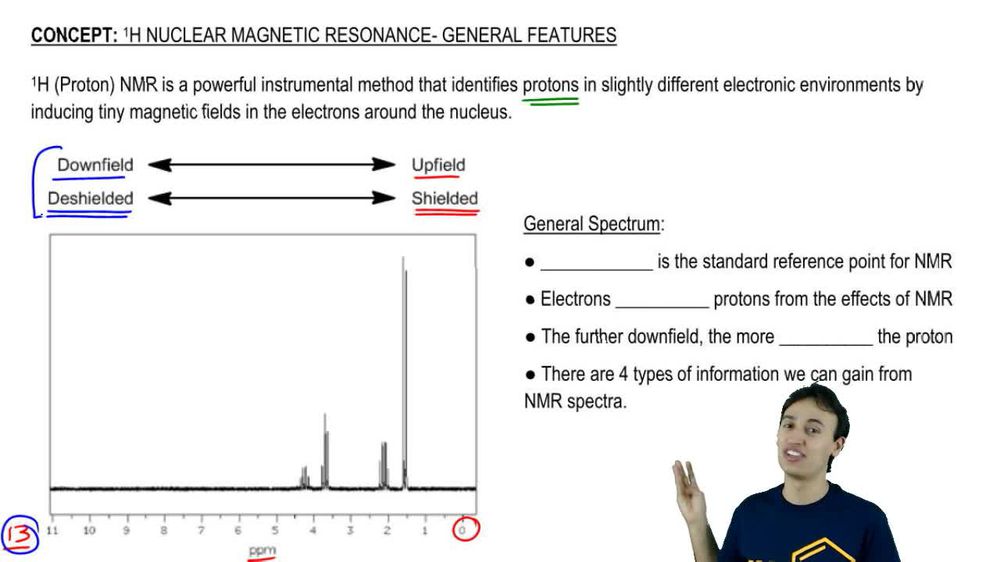
 10:06
10:06