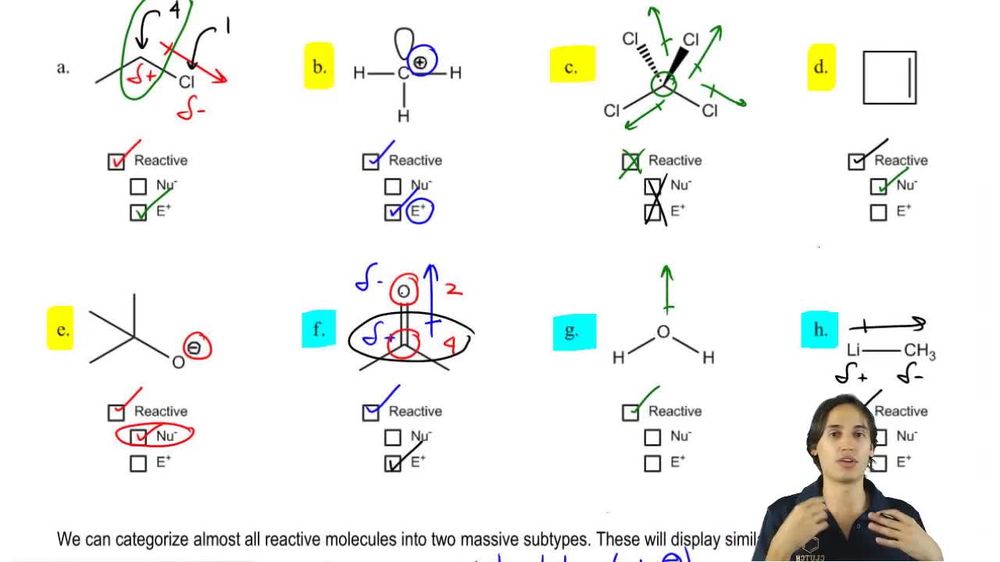
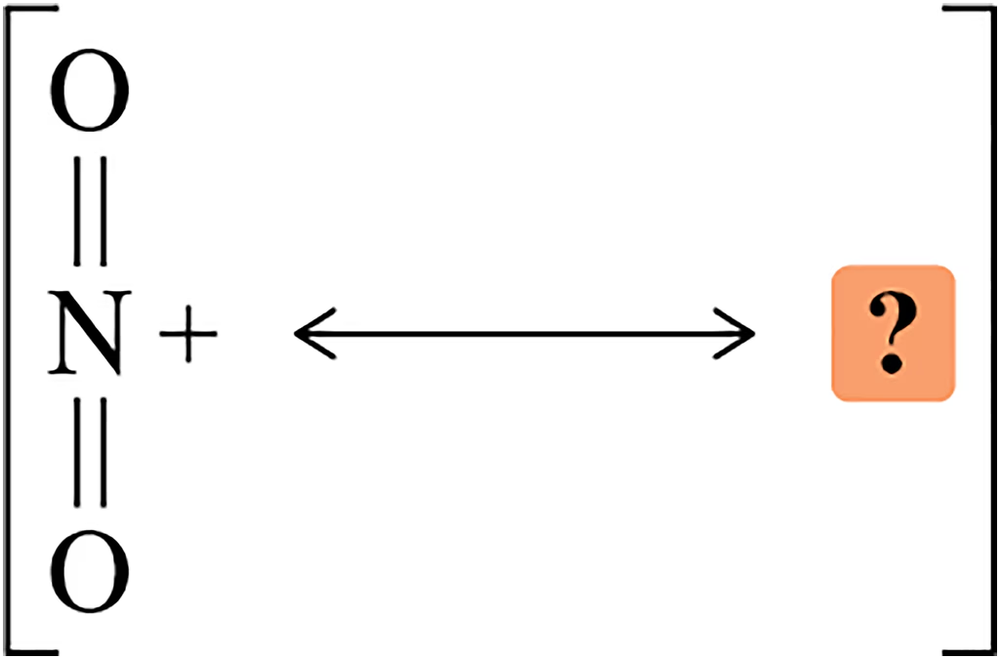
The zwitterionic form of carbonyls is often used to explain their electrophilicity. Draw the zwitterionic structure of NO+2. Why is this such a great electrophile at the central nitrogen?
Verified step by step guidance
1
Step 1: Begin by analyzing the structure of NO+2 (nitronium ion). It consists of a nitrogen atom bonded to two oxygen atoms, with a formal positive charge on the nitrogen. Both oxygen atoms are double-bonded to nitrogen, and the molecule is linear due to sp hybridization of the nitrogen atom.
Step 2: To draw the zwitterionic form, consider the resonance structures of NO+2. One resonance structure involves shifting electron density from one of the oxygen atoms toward the nitrogen, creating a formal negative charge on the oxygen and a formal positive charge on the nitrogen. This highlights the electrophilic nature of the nitrogen atom.
Step 3: The zwitterionic form emphasizes the separation of charges within the molecule. Represent the nitrogen with a positive charge and one oxygen with a negative charge, while the other oxygen remains neutral. This charge separation increases the molecule's reactivity.
Step 4: The central nitrogen in NO+2 is a great electrophile because it carries a formal positive charge, making it electron-deficient. Electrophiles are species that seek electrons, and the positive charge on nitrogen strongly attracts nucleophiles.
Step 5: Additionally, the resonance stabilization of NO+2 ensures that the positive charge on nitrogen is delocalized, making the molecule stable yet highly reactive. This combination of stability and electron deficiency enhances its electrophilic character.
Verified video answer for a similar problem:
This video solution was recommended by our tutors as helpful for the problem above
Play a video:
0 Comments
Key Concepts
Here are the essential concepts you must grasp in order to answer the question correctly.
Zwitterionic Structures
A zwitterion is a molecule that has both positive and negative charges but is overall neutral. In the context of carbonyls, zwitterionic forms can stabilize charge separation, enhancing the molecule's reactivity. Understanding how to draw and interpret these structures is crucial for analyzing their electrophilic properties.
Electrophilicity refers to the ability of a species to accept electrons, making it a key player in chemical reactions, particularly in nucleophilic attacks. The presence of a positive charge or electron-deficient atom increases a molecule's electrophilicity, which is essential for understanding why certain structures, like zwitterions, are highly reactive.
In the zwitterionic structure of NO₂⁺, the central nitrogen atom is positively charged, making it a strong electrophile. This positive charge results from the nitrogen's ability to form multiple bonds with electronegative oxygen atoms, leading to a significant electron deficiency that attracts nucleophiles during chemical reactions.

 Verified step by step guidance
 04:41
04:41