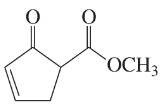
Draw complete Lewis structures, including lone pairs, for the following compounds. (g) (h)
Verified step by step guidance
1
Identify the functional groups in each compound. For compound (g), recognize the benzene ring and the sulfonic acid group (SO3H). For compound (h), identify the cyclic anhydride structure and the methoxy group (OCH3).
For compound (g), draw the benzene ring as a hexagon with alternating double bonds. Attach the sulfonic acid group to the benzene ring. The sulfur atom is bonded to three oxygen atoms, one of which is also bonded to a hydrogen atom. Include lone pairs on the oxygen atoms.
For compound (h), draw the five-membered ring with two carbonyl groups (C=O) adjacent to each other. Attach the methoxy group (OCH3) to the carbonyl carbon. Ensure to include lone pairs on the oxygen atoms.
Add lone pairs to all oxygen atoms in both compounds. Each oxygen atom should have two lone pairs, except for the oxygen in the hydroxyl group of the sulfonic acid, which will have one lone pair due to the hydrogen bond.
Verify that all atoms satisfy the octet rule where applicable, and ensure that the formal charges are minimized across the structures. Adjust any bonds or lone pairs if necessary to achieve this.
Verified video answer for a similar problem:
This video solution was recommended by our tutors as helpful for the problem above
Video duration:
4m
Play a video:
0 Comments
Key Concepts
Here are the essential concepts you must grasp in order to answer the question correctly.
Lewis Structures
Lewis structures are diagrams that represent the bonding between atoms of a molecule and the lone pairs of electrons that may exist. They are essential for visualizing the arrangement of atoms, the distribution of electrons, and the connectivity within a molecule. In drawing Lewis structures, it is crucial to account for all valence electrons and to satisfy the octet rule for each atom, where applicable.
Functional groups are specific groups of atoms within molecules that have characteristic properties and reactivity. In the given compounds, the sulfonic acid group (SO3H) and the methoxy group (OCH3) are functional groups that influence the chemical behavior of the molecules. Recognizing these groups helps in predicting the reactivity and interactions of the compounds in chemical reactions.
Aromaticity refers to the increased stability of certain cyclic, planar molecules due to the delocalization of electrons in conjugated pi systems, as seen in benzene rings. Resonance involves the depiction of a molecule by two or more valid Lewis structures, which represent the delocalization of electrons. Understanding these concepts is crucial for accurately drawing and interpreting the structure of aromatic compounds like the benzene derivative in the question.

 4:10 minutes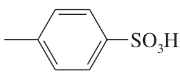
 Verified step by step guidance
 04:12
04:12