Both PCl3 and PCl5 are stable compounds. Draw Lewis structures for these two compounds.
Verified step by step guidance
1
To draw the Lewis structure for PCl3, start by identifying the total number of valence electrons. Phosphorus (P) has 5 valence electrons, and each chlorine (Cl) has 7 valence electrons. Since there are three chlorine atoms, the total number of valence electrons is 5 + (3 * 7) = 26.
Place the phosphorus atom in the center as it is less electronegative than chlorine. Arrange the three chlorine atoms around the phosphorus atom.
Draw single bonds between the phosphorus atom and each chlorine atom. Each bond represents a pair of shared electrons, so this uses up 6 electrons (3 bonds * 2 electrons per bond).
Distribute the remaining 20 electrons as lone pairs around the chlorine atoms to satisfy the octet rule. Each chlorine atom should have 3 lone pairs (6 electrons) to complete its octet.
For PCl5, calculate the total number of valence electrons: Phosphorus has 5, and each of the five chlorine atoms has 7, giving a total of 5 + (5 * 7) = 40 valence electrons. Place phosphorus in the center and arrange the five chlorine atoms around it. Form single bonds between phosphorus and each chlorine, using 10 electrons. Distribute the remaining 30 electrons as lone pairs on the chlorine atoms, ensuring each chlorine has an octet.
Verified video answer for a similar problem:
This video solution was recommended by our tutors as helpful for the problem above
Video duration:
4m
Play a video:
0 Comments
Key Concepts
Here are the essential concepts you must grasp in order to answer the question correctly.
Lewis Structures
Lewis structures are diagrams that represent the bonding between atoms of a molecule and the lone pairs of electrons that may exist. They are essential for visualizing the arrangement of electrons around atoms, which helps in predicting the shape, reactivity, and properties of the molecule. In drawing Lewis structures, it is important to account for all valence electrons and ensure that atoms achieve a stable electron configuration, often resembling the nearest noble gas.
Valence electrons are the outermost electrons of an atom and are crucial in determining how atoms interact and bond with each other. For phosphorus (P), which is in group 15 of the periodic table, there are five valence electrons. Understanding the number of valence electrons is key to drawing accurate Lewis structures, as it dictates how many bonds an atom can form and how many lone pairs it may have.
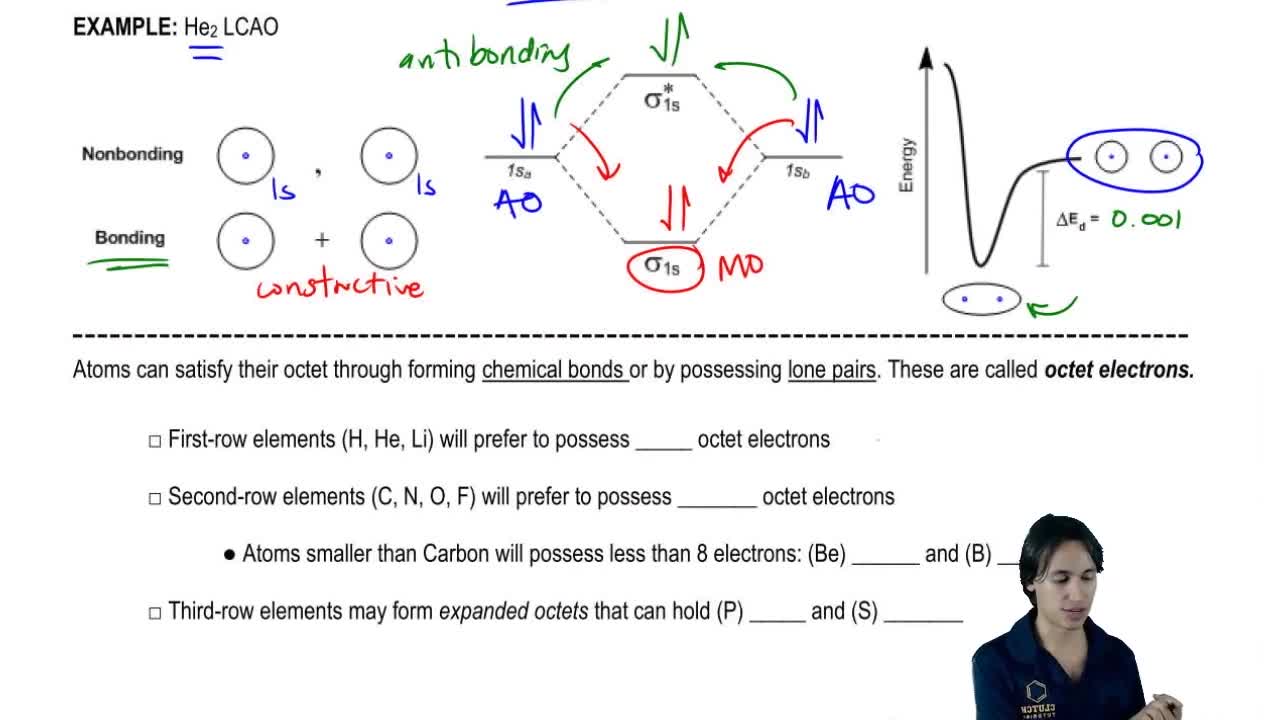
The octet rule states that atoms tend to form bonds until they are surrounded by eight valence electrons, achieving a stable electron configuration. However, elements in period 3 and beyond, like phosphorus, can have an expanded octet, meaning they can hold more than eight electrons. This is due to the availability of d-orbitals, allowing compounds like PCl5 to exist with phosphorus having ten electrons in its valence shell.

 4:57 minutes
 Verified step by step guidance
 04:12
04:12