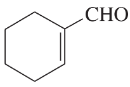
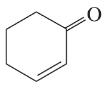
Give Lewis structures corresponding to the following line–angle structures. Give the molecular formula for each structure. (e) (f)
Verified step by step guidance
1
Step 1: Identify the functional groups in each line-angle structure. In structure (e), the 'CHO' group represents an aldehyde. In structure (f), the 'O' with a double bond represents a ketone.
Step 2: For structure (e), draw the Lewis structure of the cyclohexene ring. Cyclohexene is a six-membered ring with one double bond. Each vertex represents a carbon atom, and the double bond indicates two shared pairs of electrons between two carbon atoms.
Step 3: Add the aldehyde group to structure (e). The 'CHO' group consists of a carbonyl group (C=O) and a hydrogen atom attached to the carbon. Ensure the carbon in the aldehyde group is connected to the cyclohexene ring.
Step 4: For structure (f), draw the Lewis structure of the cyclohexene ring similar to structure (e). The ketone group is represented by a carbonyl group (C=O) attached to the ring.
Step 5: Determine the molecular formula for each structure. Count the number of carbon, hydrogen, and oxygen atoms in each structure to write the molecular formula. For structure (e), include the atoms from the cyclohexene ring and the aldehyde group. For structure (f), include the atoms from the cyclohexene ring and the ketone group.
Verified video answer for a similar problem:
This video solution was recommended by our tutors as helpful for the problem above
Video duration:
3m
Play a video:
0 Comments
Key Concepts
Here are the essential concepts you must grasp in order to answer the question correctly.
Lewis Structures
Lewis structures are diagrams that represent the bonding between atoms in a molecule and the lone pairs of electrons that may exist. They use dots to represent electrons and lines to represent bonds between atoms. Understanding how to draw Lewis structures is essential for visualizing molecular geometry and predicting reactivity.
Line-angle structures, also known as skeletal structures, are a shorthand way of drawing organic molecules. In these diagrams, vertices represent carbon atoms, and lines represent bonds, with hydrogen atoms often omitted for simplicity. Recognizing how to convert line-angle structures to Lewis structures is crucial for accurately depicting molecular formulas.
A molecular formula indicates the number and types of atoms present in a molecule, represented by chemical symbols and subscripts. It provides essential information about the composition of a compound but does not convey structural information. Determining the molecular formula from Lewis or line-angle structures is a key skill in organic chemistry.