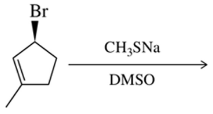
Predict the product of the following substitution reactions, paying close attention to the stereochemical outcome of the reactions. (b)
Verified step by step guidance
1
Analyze the reaction conditions: The presence of CH3SNa (sodium methanethiolate) and DMSO (dimethyl sulfoxide) suggests that this is an SN2 reaction. SN2 reactions are bimolecular nucleophilic substitutions that proceed with inversion of stereochemistry at the carbon center undergoing substitution.
Identify the substrate: The substrate is a bromocyclopentane derivative with a bromine atom attached to a stereogenic center. Bromine is a good leaving group, making this substrate suitable for an SN2 reaction.
Determine the nucleophile: CH3SNa provides the nucleophile CH3S⁻ (methanethiolate ion), which is a strong nucleophile due to its negative charge and sulfur atom's nucleophilicity.
Predict the stereochemical outcome: In an SN2 reaction, the nucleophile attacks the electrophilic carbon from the side opposite to the leaving group (backside attack). This results in inversion of configuration at the stereogenic center.
Write the product structure: Replace the bromine atom with the CH3S group, ensuring that the stereochemistry is inverted relative to the original configuration of the bromine atom. The product will be a cyclopentane derivative with the CH3S group attached in the opposite stereochemical orientation.
Verified video answer for a similar problem:
This video solution was recommended by our tutors as helpful for the problem above
Play a video:
0 Comments
Key Concepts
Here are the essential concepts you must grasp in order to answer the question correctly.
Nucleophilic Substitution Reactions
Nucleophilic substitution reactions involve the replacement of a leaving group in a molecule by a nucleophile. These reactions can occur via two main mechanisms: SN1 and SN2. The SN1 mechanism is a two-step process that involves the formation of a carbocation intermediate, while the SN2 mechanism is a one-step process where the nucleophile attacks the substrate simultaneously as the leaving group departs.
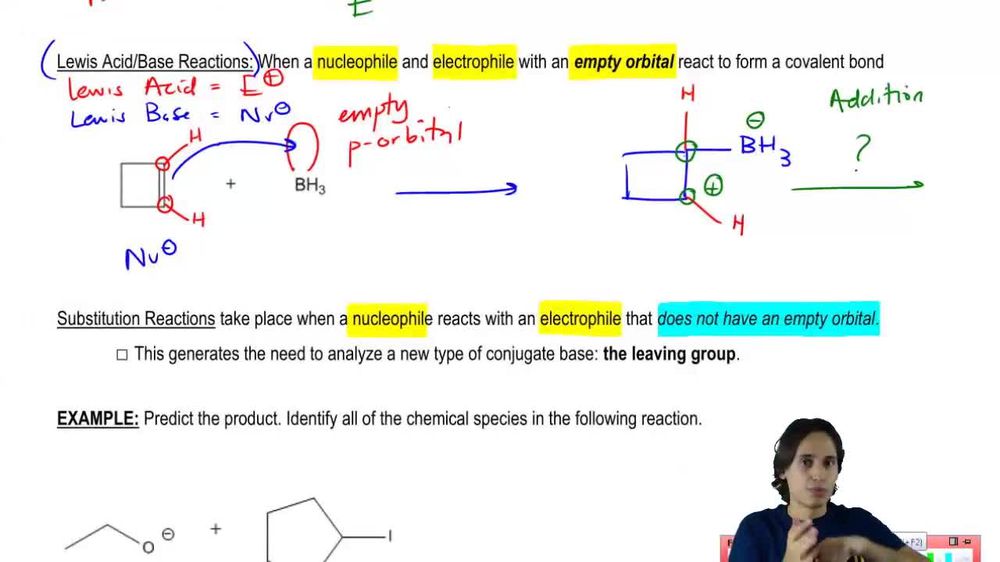
Nucleophiles and Electrophiles can react in Substitution Reactions.
Stereochemistry
Stereochemistry refers to the study of the spatial arrangement of atoms in molecules and how this affects their chemical behavior. In substitution reactions, the stereochemical outcome is crucial, especially in SN2 reactions, where the nucleophile attacks from the opposite side of the leaving group, leading to inversion of configuration. Understanding stereochemistry helps predict the 3D orientation of the product.
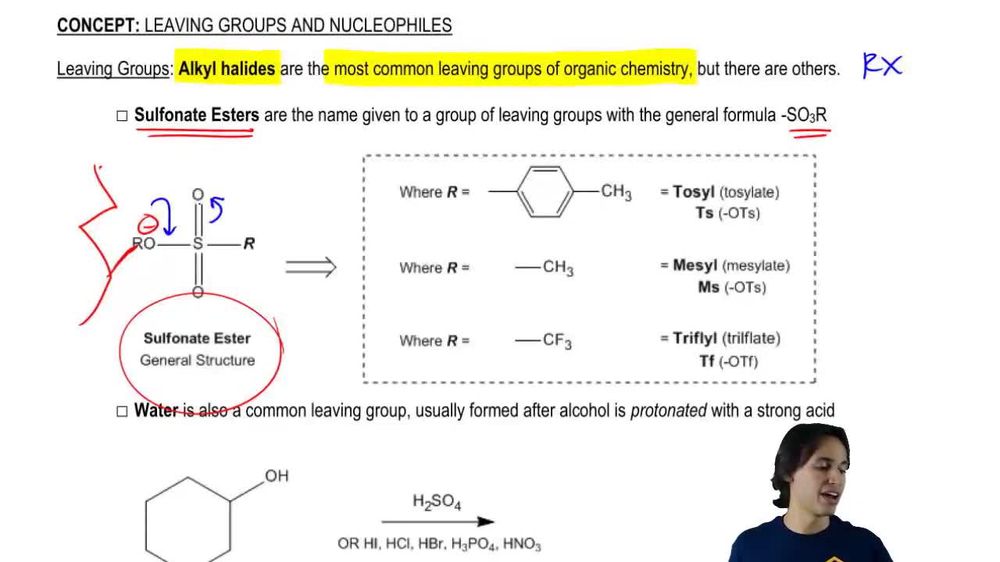
Leaving groups are atoms or groups that can depart from the parent molecule during a chemical reaction, facilitating nucleophilic substitution. A good leaving group is typically stable after departure, such as halides or sulfonate groups. The nature of the leaving group significantly influences the reaction rate and mechanism, making it essential to identify them when predicting reaction products.