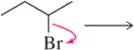
Predict the product that results from the following 'pushed electrons.' (a)
Verified step by step guidance
1
Step 1: Analyze the given reaction mechanism and identify the 'pushed electrons' in the provided structure. Pushed electrons typically indicate movement of electron density, such as bond breaking, bond formation, or resonance.
Step 2: Determine the type of reaction occurring. Common possibilities include nucleophilic substitution, elimination, addition, or rearrangement. Look for key features like leaving groups, double bonds, or lone pairs that guide the electron flow.
Step 3: Follow the electron movement step by step. Use curved arrows to track how electrons move from one atom or bond to another. Ensure that all atoms obey the octet rule and formal charge considerations during this process.
Step 4: Predict the intermediate(s) formed during the reaction. If the electron movement results in a new bond or breaks an existing bond, draw the intermediate structure(s) and check for stability (e.g., resonance stabilization or carbocation rearrangement).
Step 5: Identify the final product by completing the reaction mechanism. Ensure that all atoms are properly bonded, charges are balanced, and the structure reflects the electron movement described in the mechanism.
Verified video answer for a similar problem:
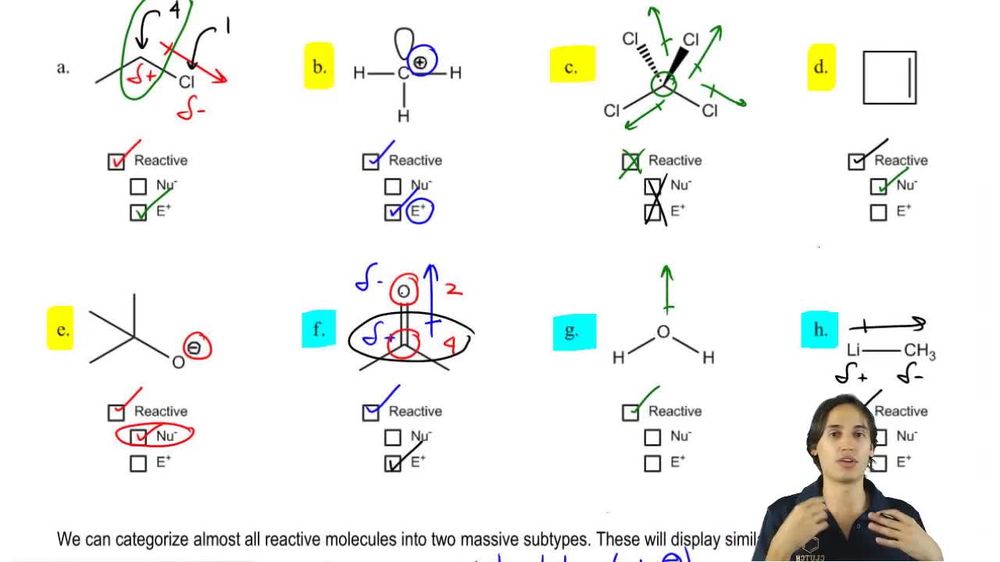
This video solution was recommended by our tutors as helpful for the problem above
Video duration:
3m
Play a video:
0 Comments
Key Concepts
Here are the essential concepts you must grasp in order to answer the question correctly.
Electron Pushing Mechanism
The electron pushing mechanism is a fundamental concept in organic chemistry that illustrates how electrons move during chemical reactions. It involves the use of curved arrows to represent the movement of electron pairs from nucleophiles to electrophiles, helping to visualize the formation and breaking of bonds. Understanding this mechanism is crucial for predicting reaction products.
Nucleophiles are species that donate an electron pair to form a chemical bond, while electrophiles are electron-deficient species that accept electron pairs. Recognizing the roles of nucleophiles and electrophiles in a reaction is essential for predicting the outcome of electron pushing, as it determines how reactants will interact and what products will form.
A reaction mechanism is a step-by-step description of how a chemical reaction occurs, detailing the sequence of bond-breaking and bond-forming events. Understanding reaction mechanisms allows chemists to predict the products of reactions based on the movement of electrons and the stability of intermediates. This knowledge is vital for analyzing complex organic reactions.