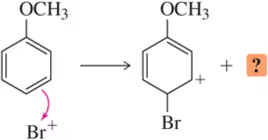
The following reaction steps are shown using conventional electron pushing. (b) Use the bouncing arrow formalism to illustrate the formation of only the product shown. (c)
Verified step by step guidance
1
Step 1: Analyze the starting material, which is a cyclohexene ring with a double bond. The bromine atom (:Br) is shown with a lone pair of electrons and a positive charge, indicating it is an electrophile.
Step 2: Using the bouncing arrow formalism, illustrate the interaction between the π-electrons of the double bond in cyclohexene and the electrophilic bromine atom. The π-electrons will attack the bromine atom, forming a bond between one of the carbons in the double bond and the bromine.
Step 3: As the π-electrons attack the bromine, the double bond is broken, and a carbocation is formed on the adjacent carbon. This carbocation is stabilized by the structure of the cyclohexane ring.
Step 4: The bromine atom now forms a bond with one of the carbons from the original double bond, resulting in the bromine being attached to the cyclohexane ring. The carbocation remains on the adjacent carbon.
Step 5: The product shown in the image is a bromocyclohexane with a carbocation on the adjacent carbon. Ensure the bouncing arrow formalism clearly illustrates the movement of electrons during the reaction.
Verified video answer for a similar problem:
This video solution was recommended by our tutors as helpful for the problem above
Video duration:
3m
Play a video:
0 Comments
Key Concepts
Here are the essential concepts you must grasp in order to answer the question correctly.
Electron Pushing Mechanism
The electron pushing mechanism, often depicted with curved arrows, illustrates the movement of electron pairs during chemical reactions. This method helps visualize how nucleophiles attack electrophiles, leading to bond formation or breaking. Understanding this concept is crucial for predicting reaction outcomes and mechanisms in organic chemistry.
Bouncing arrow formalism is a specific representation used to depict the flow of electrons in a reaction, particularly in resonance structures or when showing the stabilization of charges. This method emphasizes the dynamic nature of electron movement, allowing chemists to visualize how intermediates and products are formed during a reaction. Mastery of this formalism is essential for accurately illustrating complex mechanisms.
Electrophilic addition reactions involve the addition of an electrophile to a nucleophile, typically across a double bond. In the context of the provided reaction, a bromine molecule acts as the electrophile, adding to the alkene to form a bromoalkane. Understanding the nature of electrophiles and nucleophiles is fundamental for predicting the products of such reactions and their mechanisms.