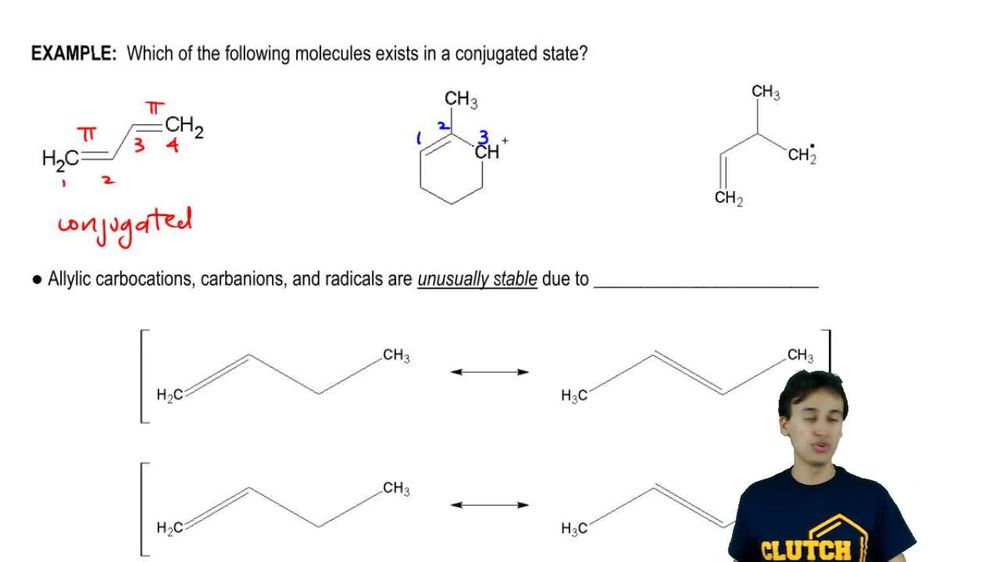
Classify the following dienes and polyenes as isolated, conjugated, cumulated, or some combination of these classifications. (a) cycloocta-1,4-diene (b) cycloocta-1,3-diene (c) cyclodeca-1,2-diene (d) cycloocta-1,3,5,7-tetraene (e) cyclohexa-1,3,5-triene (benzene) (f) penta-1,2,4-triene
Verified step by step guidance
1
Step 1: Understand the classifications of dienes and polyenes. Isolated dienes have double bonds separated by more than one single bond. Conjugated dienes have alternating single and double bonds. Cumulated dienes have adjacent double bonds. Some molecules may exhibit combinations of these classifications.
Step 2: Analyze structure (a) cycloocta-1,4-diene. The double bonds are separated by two single bonds, making them isolated dienes.
Step 3: Analyze structure (b) cycloocta-1,3-diene. The double bonds are separated by one single bond, forming a conjugated diene.
Step 4: Analyze structure (c) cyclodeca-1,2-diene. The double bonds are adjacent, making this a cumulated diene.
Step 5: Analyze structure (d) cycloocta-1,3,5,7-tetraene and (e) cyclohexa-1,3,5-triene (benzene). Both structures exhibit alternating single and double bonds throughout the ring, classifying them as conjugated polyenes. For structure (f) penta-1,2,4-triene, the molecule contains both cumulated and conjugated double bonds, as the first two double bonds are adjacent (cumulated), and the second and third double bonds are separated by one single bond (conjugated).
Verified video answer for a similar problem:
This video solution was recommended by our tutors as helpful for the problem above
Video duration:
4m
Play a video:
0 Comments
Key Concepts
Here are the essential concepts you must grasp in order to answer the question correctly.
Diene Classification
Dienes are classified based on the arrangement of their double bonds. Isolated dienes have double bonds separated by more than one single bond, conjugated dienes have alternating double and single bonds, and cumulated dienes have two or more double bonds directly adjacent to each other. Understanding these classifications is essential for predicting reactivity and stability in organic reactions.
Conjugation occurs when p-orbitals overlap across adjacent double bonds, allowing for delocalization of electrons. This delocalization stabilizes the molecule and can affect its reactivity and color. Conjugated systems often exhibit unique properties, such as lower energy transitions, which are important in fields like organic electronics and photochemistry.
Cycloalkenes are cyclic compounds that contain one or more double bonds. The geometry and strain of these rings can influence the stability and reactivity of the compound. For example, smaller rings may experience angle strain, while larger rings can accommodate multiple double bonds, leading to various classifications of dienes and polyenes based on their structure.