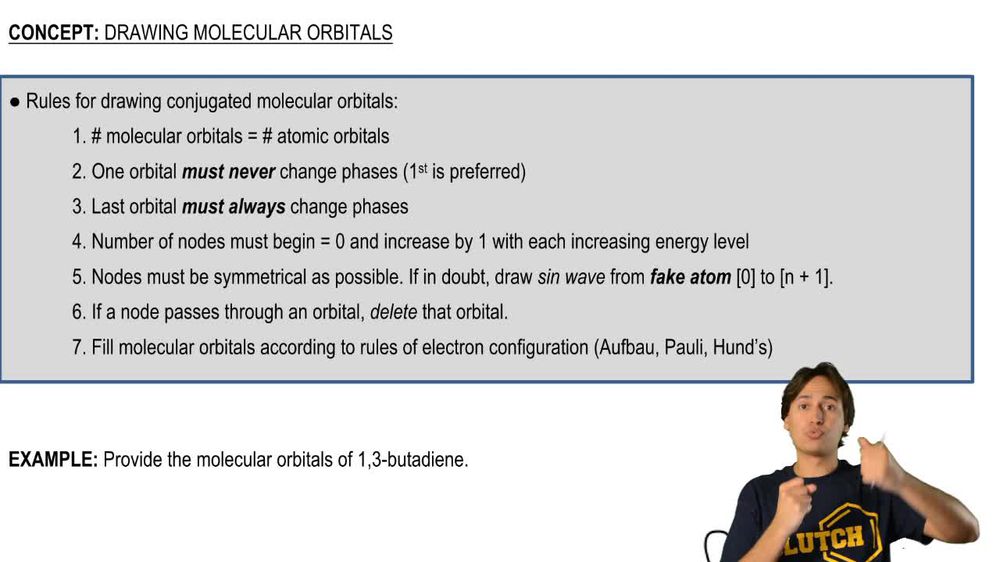
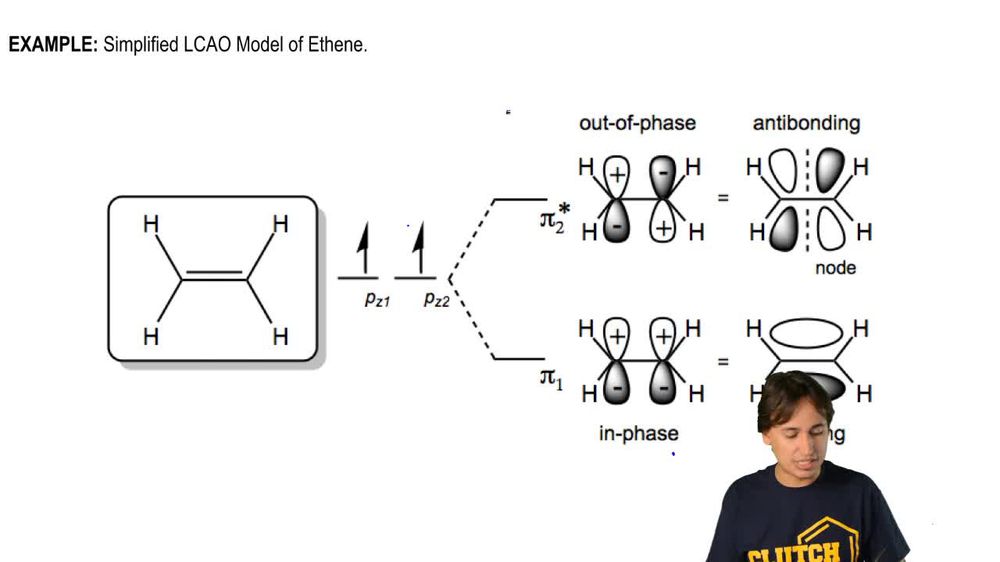
Answer the following questions for the molecular orbitals (MOs) of 1,3,5,7-octatetraene: f. What is the relationship between HOMO and LUMO and symmetric and antisymmetric orbitals?
Verified step by step guidance
1
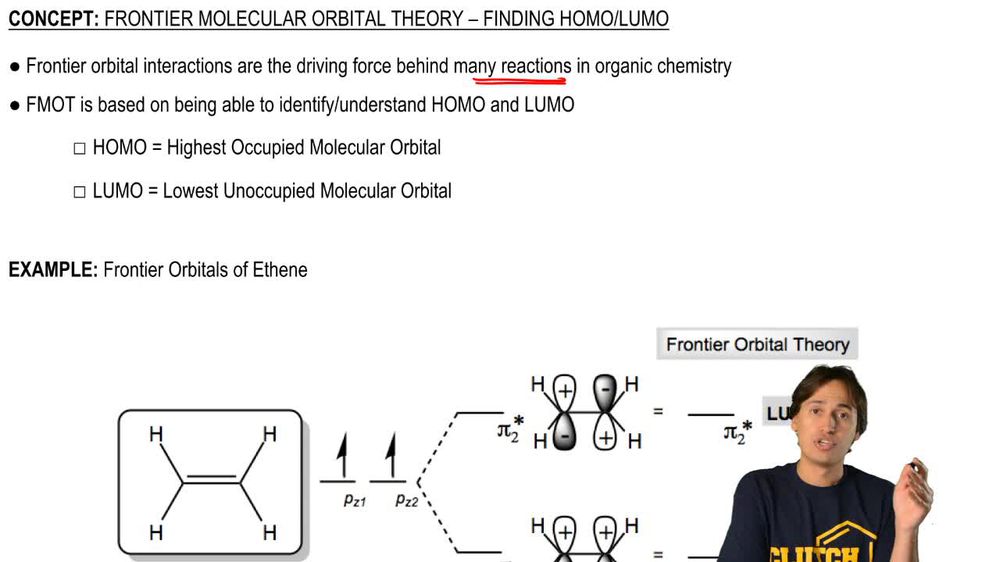
Understand the terms HOMO (Highest Occupied Molecular Orbital) and LUMO (Lowest Unoccupied Molecular Orbital). These are the frontier orbitals in a molecule, where the HOMO is the highest energy orbital containing electrons, and the LUMO is the lowest energy orbital that is empty and can accept electrons.
Recognize that molecular orbitals (MOs) in conjugated systems like 1,3,5,7-octatetraene are formed by the combination of atomic p orbitals. These MOs can be classified as symmetric or antisymmetric based on their behavior under reflection or inversion symmetry operations.
Recall that symmetric orbitals remain unchanged under symmetry operations (e.g., reflection through a plane or inversion), while antisymmetric orbitals change sign under these operations.
In conjugated systems, the HOMO is typically the highest energy bonding orbital, which may exhibit either symmetric or antisymmetric properties depending on the specific molecular system. Similarly, the LUMO is the lowest energy antibonding orbital and also exhibits symmetry properties.
The relationship between HOMO and LUMO and their symmetry is crucial in determining the electronic transitions in the molecule. For example, transitions between orbitals (e.g., HOMO to LUMO) are governed by selection rules, which depend on the symmetry properties of the orbitals involved. In 1,3,5,7-octatetraene, analyze the symmetry of the HOMO and LUMO to predict allowed transitions and reactivity patterns.
Verified video answer for a similar problem:
This video solution was recommended by our tutors as helpful for the problem above
Video duration:
10m
Play a video:
0 Comments
Key Concepts
Here are the essential concepts you must grasp in order to answer the question correctly.
HOMO and LUMO
HOMO (Highest Occupied Molecular Orbital) and LUMO (Lowest Unoccupied Molecular Orbital) are critical concepts in molecular orbital theory. The HOMO is the highest energy orbital that contains electrons, while the LUMO is the lowest energy orbital that is empty. The energy gap between these two orbitals is significant for understanding the reactivity and electronic properties of a molecule, as it influences how the molecule interacts with light and other chemical species.
Symmetric and antisymmetric orbitals refer to the behavior of molecular orbitals under inversion through a center of symmetry. Symmetric orbitals remain unchanged when the coordinates of the electrons are inverted, while antisymmetric orbitals change sign. This distinction is important in determining the allowed transitions between orbitals, as certain selection rules apply based on the symmetry properties of the orbitals involved.
The interaction between HOMO and LUMO can be influenced by their symmetry properties. For example, transitions between orbitals are allowed when the initial and final states have compatible symmetry. In the case of symmetric and antisymmetric orbitals, the nature of these interactions can dictate the likelihood of electronic transitions, which is crucial for understanding the optical properties and reactivity of conjugated systems like 1,3,5,7-octatetraene.