Answer the following questions for the molecular orbitals (MOs) of 1,3,5,7-octatetraene: b. Which are the bonding MOs, and which are the antibonding MOs?
Verified step by step guidance
1
Step 1: Understand the molecular orbital (MO) theory for conjugated systems. In 1,3,5,7-octatetraene, there are 8 Ο-electrons from the 4 conjugated double bonds. These Ο-electrons will occupy molecular orbitals formed by the overlap of p-orbitals on the carbon atoms in the conjugated system.
Step 2: Recall that the number of molecular orbitals equals the number of atomic p-orbitals involved. For 1,3,5,7-octatetraene, there are 8 carbon atoms with p-orbitals, so there will be 8 molecular orbitals (Οβ, Οβ, Οβ, ..., Οβ).
Step 3: Bonding MOs are those with lower energy than the isolated p-orbitals, and they result from constructive interference of wave functions. These orbitals have no or fewer nodes (regions of zero electron density) between adjacent atoms. For 1,3,5,7-octatetraene, the bonding MOs are typically the lowest-energy orbitals (e.g., Οβ, Οβ, etc.).
Step 4: Antibonding MOs are those with higher energy than the isolated p-orbitals, and they result from destructive interference of wave functions. These orbitals have more nodes between adjacent atoms. For 1,3,5,7-octatetraene, the antibonding MOs are the highest-energy orbitals (e.g., Οβ, Οβ, etc.).
Step 5: To determine which specific MOs are bonding or antibonding, analyze the nodal patterns of each orbital. Bonding MOs (e.g., Οβ, Οβ) have fewer nodes, while antibonding MOs (e.g., Οβ, Οβ) have the most nodes. Orbitals in the middle (e.g., Οβ, Οβ ) are non-bonding or have mixed characteristics.
Verified video answer for a similar problem:
This video solution was recommended by our tutors as helpful for the problem above
Video duration:
3m
Play a video:
0 Comments
Key Concepts
Here are the essential concepts you must grasp in order to answer the question correctly.
Molecular Orbitals (MOs)
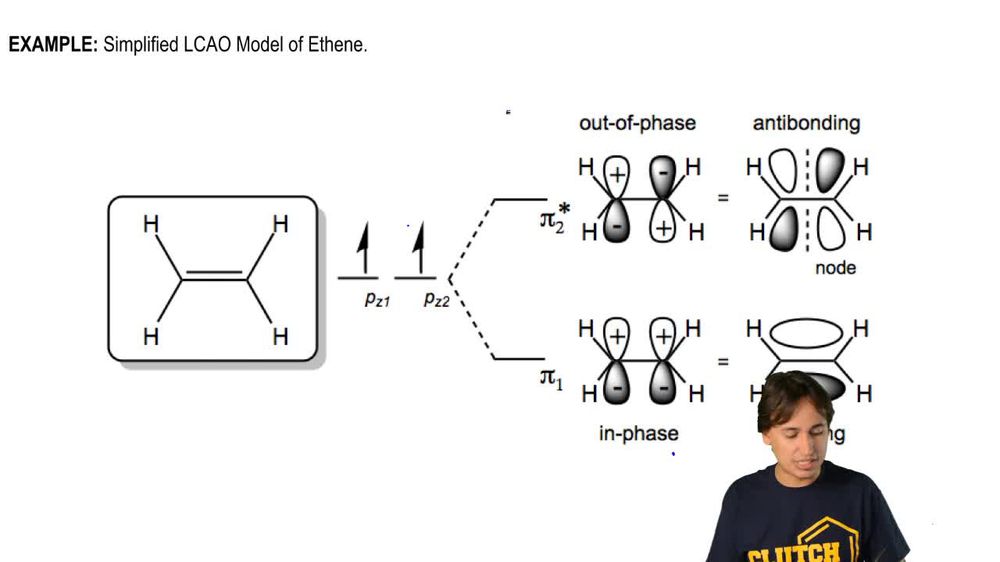
Molecular orbitals are formed by the linear combination of atomic orbitals (LCAO) when atoms bond together. They can be classified as bonding, antibonding, or non-bonding. Bonding MOs lower the energy of the system and stabilize the molecule, while antibonding MOs increase energy and destabilize it. Understanding the arrangement and energy levels of these orbitals is crucial for predicting molecular stability and reactivity.
Bonding MOs are formed when atomic orbitals combine constructively, resulting in increased electron density between the nuclei, which stabilizes the molecule. In contrast, antibonding MOs arise from destructive interference of atomic orbitals, leading to a node between the nuclei and decreased electron density in that region, thus destabilizing the molecule. Identifying these orbitals is essential for understanding the electronic structure of molecules like 1,3,5,7-octatetraene.
1,3,5,7-octatetraene is a conjugated hydrocarbon with alternating double bonds, which allows for delocalization of Ο electrons across the molecule. This delocalization leads to the formation of several Ο molecular orbitals, which can be filled according to the Aufbau principle. The specific arrangement of these MOs determines which are bonding and which are antibonding, influencing the molecule's stability and reactivity.