Draw Lewis structures for the following compounds. e. dimethylamine, CH3NHCH3 f. diethyl ether, CH3CH2OCH2CH3 g. 1-chloropropane,CH3CH2CH2Cl
Verified step by step guidance
1
To draw the Lewis structure for dimethylamine (CH3NHCH3), start by identifying the central atom, which is nitrogen (N). Connect the nitrogen atom to two methyl groups (CH3) and one hydrogen atom (H). Ensure that nitrogen has a lone pair of electrons to complete its octet.
For diethyl ether (CH3CH2OCH2CH3), identify the central atom as oxygen (O). Connect the oxygen atom to two ethyl groups (CH3CH2). Each carbon atom in the ethyl groups should form four bonds, and the oxygen should have two lone pairs to complete its octet.
In the case of 1-chloropropane (CH3CH2CH2Cl), start by drawing a three-carbon chain. Attach a chlorine atom (Cl) to the terminal carbon atom. Ensure that each carbon atom forms four bonds, and the chlorine atom has three lone pairs to complete its octet.
For each compound, ensure that all hydrogen atoms are connected to carbon atoms, and each carbon atom forms four bonds, either with hydrogen, carbon, or other atoms like nitrogen, oxygen, or chlorine.
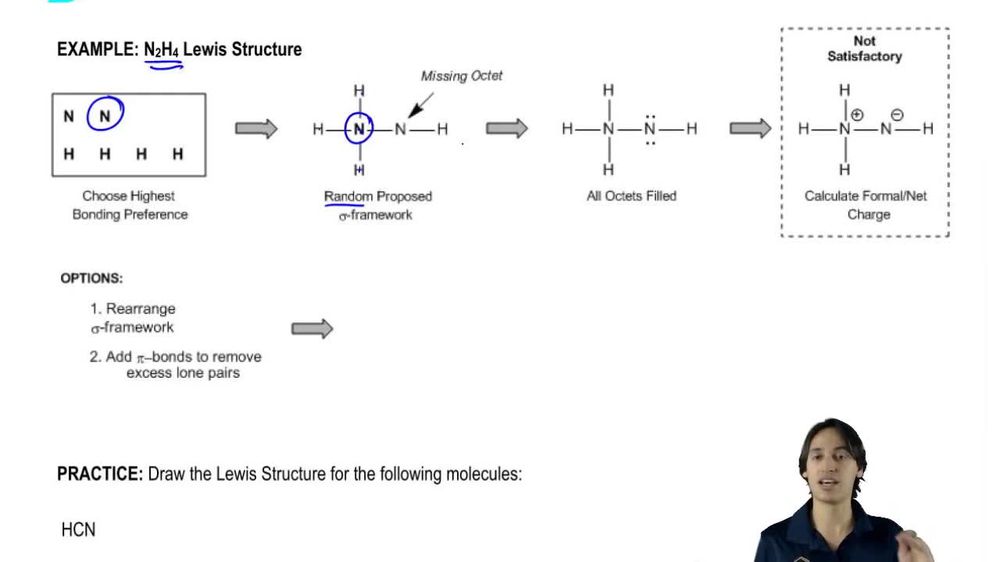
Check that all atoms satisfy the octet rule (except hydrogen, which follows the duet rule) and that the total number of valence electrons used in the structure matches the sum of valence electrons for each atom in the compound.
Verified video answer for a similar problem:
This video solution was recommended by our tutors as helpful for the problem above
Video duration:
3m
Play a video:
0 Comments
Key Concepts
Here are the essential concepts you must grasp in order to answer the question correctly.
Lewis Structures
Lewis structures are diagrams that represent the bonding between atoms of a molecule and the lone pairs of electrons that may exist. They are essential for visualizing the arrangement of atoms, the distribution of electrons, and the types of bonds (single, double, or triple) in a molecule. Understanding how to draw Lewis structures helps in predicting the geometry, reactivity, and properties of the compound.
Valence electrons are the outermost electrons of an atom and are crucial in forming chemical bonds. In drawing Lewis structures, it is important to account for all valence electrons to ensure that each atom achieves a stable electron configuration, often resembling the nearest noble gas. This involves distributing electrons to satisfy the octet rule for most atoms, except for hydrogen, which follows the duet rule.
Functional groups are specific groups of atoms within molecules that have characteristic properties and reactivity. In organic chemistry, recognizing functional groups like amines, ethers, and halides is essential for understanding the behavior of molecules. For example, dimethylamine contains an amine group, diethyl ether contains an ether group, and 1-chloropropane contains a halide group, each influencing the molecule's chemical properties and interactions.

 3:41 minutes
 Verified step by step guidance
 04:12
04:12