Propose mechanisms consistent with the following reactions. (b)
Verified step by step guidance
1
Step 1: Analyze the reaction conditions. The presence of H₂SO₄ (sulfuric acid) and H₂O (water) indicates that this is an acid-catalyzed hydration reaction of an alkene. The goal is to add water (H and OH) across the double bond.
Step 2: Protonation of the alkene. The π electrons of the double bond attack a proton (H⁺) from H₂SO₄, forming a carbocation intermediate. The more stable carbocation will form, so consider carbocation rearrangements if applicable.
Step 3: Nucleophilic attack by water. The water molecule acts as a nucleophile and attacks the carbocation, forming an oxonium ion (R-OH₂⁺).
Step 4: Deprotonation of the oxonium ion. A water molecule or another base removes a proton from the oxonium ion, resulting in the formation of the alcohol product.
Step 5: Verify the Markovnikov addition. The OH group is added to the more substituted carbon of the double bond, consistent with Markovnikov's rule, due to the stability of the carbocation intermediate.
Verified video answer for a similar problem:
This video solution was recommended by our tutors as helpful for the problem above
Video duration:
5m
Play a video:
0 Comments
Key Concepts
Here are the essential concepts you must grasp in order to answer the question correctly.
Electrophilic Addition
Electrophilic addition is a fundamental reaction mechanism in organic chemistry where an electrophile reacts with a nucleophile, typically involving alkenes or alkynes. In this context, the double bond of the alkene acts as a nucleophile, attacking the electrophilic sulfuric acid (H2SO4), leading to the formation of a carbocation intermediate. This step is crucial for understanding how the reaction proceeds to form the final product.
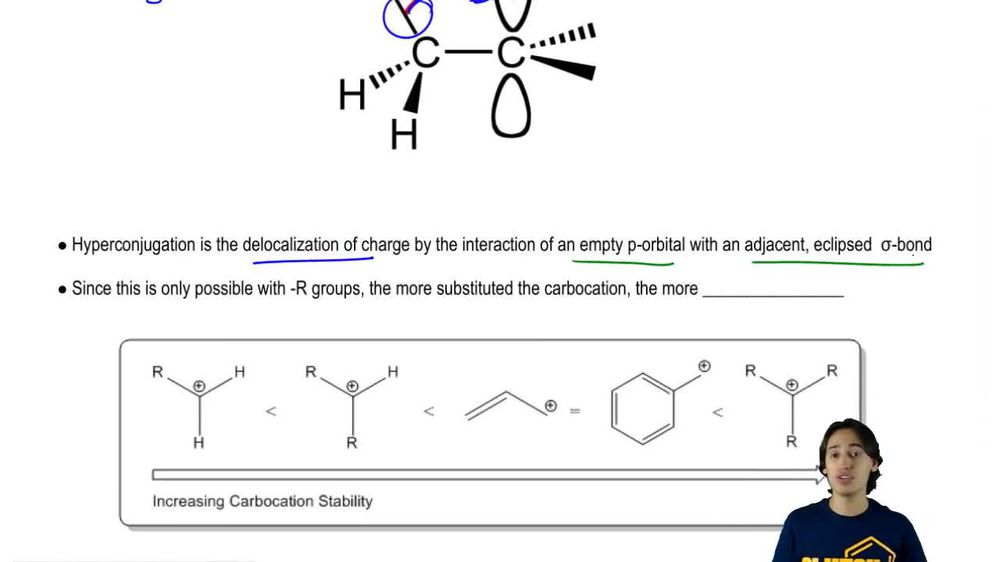
Carbocation stability is a key concept in organic reactions, as the stability of the carbocation intermediate significantly influences the reaction pathway. Carbocations can be classified as primary, secondary, or tertiary, with tertiary carbocations being the most stable due to hyperconjugation and inductive effects. Understanding the stability of the carbocation formed during the electrophilic addition helps predict the major product of the reaction.
A hydration reaction involves the addition of water (H2O) to a compound, typically resulting in the formation of an alcohol. In the presence of sulfuric acid, water acts as a nucleophile that attacks the carbocation formed during the electrophilic addition, leading to the final product, which is an alcohol in this case. This reaction is essential for converting alkenes into alcohols, showcasing the importance of acid-catalyzed hydration in organic synthesis.

 5:15 minutes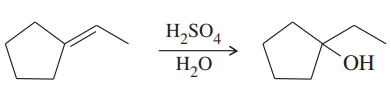
 Verified step by step guidance
 09:23
09:23