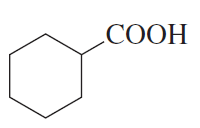
Using bromocyclohexane as a starting material, how could you synthesize the following compounds? c.
Verified step by step guidance
1
Step 1: Begin with bromocyclohexane as the starting material. Bromocyclohexane contains a bromine atom attached to a cyclohexane ring, making it a good candidate for nucleophilic substitution reactions.
Step 2: Perform a nucleophilic substitution reaction to replace the bromine atom with a cyano group (-CN). Use a cyanide salt such as NaCN or KCN in an appropriate solvent like DMSO. This reaction proceeds via an SN2 mechanism, resulting in cyclohexyl cyanide.
Step 3: Hydrolyze the cyano group (-CN) to a carboxylic acid (-COOH). This can be achieved by heating cyclohexyl cyanide with aqueous acid (e.g., HCl or H2SO4) or a base (e.g., NaOH) followed by acidification. The cyano group undergoes hydrolysis to form cyclohexanecarboxylic acid.
Step 4: Purify the product, cyclohexanecarboxylic acid, using techniques such as recrystallization or distillation, depending on the physical properties of the compound.
Step 5: Confirm the structure of the synthesized compound using spectroscopic methods such as IR (to check for the presence of the carboxylic acid functional group) and NMR (to verify the cyclohexane ring and carboxylic acid substitution).
Verified video answer for a similar problem:
This video solution was recommended by our tutors as helpful for the problem above
Video duration:
1m
Play a video:
0 Comments
Key Concepts
Here are the essential concepts you must grasp in order to answer the question correctly.
Nucleophilic Substitution
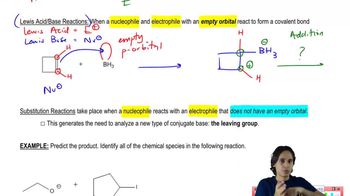
Nucleophilic substitution is a fundamental reaction in organic chemistry where a nucleophile attacks an electrophilic carbon atom, replacing a leaving group. In the case of bromocyclohexane, the bromine atom acts as a leaving group, allowing nucleophiles such as hydroxide ions or carboxylate ions to replace it, leading to the formation of new functional groups.
Nucleophiles and Electrophiles can react in Substitution Reactions.
Carboxylic Acid Formation
Carboxylic acids are organic compounds characterized by the presence of a carboxyl group (-COOH). They can be synthesized from alcohols or alkyl halides through oxidation or substitution reactions. In this context, converting bromocyclohexane to a carboxylic acid involves nucleophilic substitution followed by oxidation, which introduces the carboxyl group to the cyclohexane ring.
Rearrangement reactions involve the structural reorganization of a molecule to form a new isomer. In the synthesis of the desired carboxylic acid from bromocyclohexane, a rearrangement may be necessary to ensure that the carboxyl group is positioned correctly on the cyclohexane ring. Understanding these reactions is crucial for predicting the outcome of synthetic pathways in organic chemistry.