Show how you would synthesize the following carboxylic acids, using the indicated starting materials. (d) butan-2-ol → 2-methylbutanoic acid
Verified step by step guidance
1
Step 1: Begin by oxidizing butan-2-ol to form the corresponding ketone, butan-2-one. This can be achieved using an oxidizing agent such as PCC (Pyridinium Chlorochromate) or Jones reagent. The reaction involves the removal of two hydrogen atoms from the alcohol group.
Step 2: Perform a nucleophilic addition reaction to introduce a methyl group at the alpha-carbon of butan-2-one. This can be done using a Grignard reagent (e.g., CH3MgBr) or an organolithium reagent, followed by acidic workup to yield 3-methylbutan-2-ol.
Step 3: Oxidize 3-methylbutan-2-ol to form 3-methylbutan-2-one. Use an oxidizing agent such as PCC or Jones reagent to convert the secondary alcohol into a ketone.
Step 4: Perform a haloform reaction to convert 3-methylbutan-2-one into 2-methylbutanoic acid. This reaction involves treating the ketone with excess halogen (e.g., I2 or Br2) in the presence of a base (e.g., NaOH), followed by acidification to yield the carboxylic acid.
Step 5: Purify the 2-methylbutanoic acid product using techniques such as recrystallization or distillation, depending on the physical properties of the compound.
Verified video answer for a similar problem:
This video solution was recommended by our tutors as helpful for the problem above
Video duration:
1m
Play a video:
0 Comments
Key Concepts
Here are the essential concepts you must grasp in order to answer the question correctly.
Carboxylic Acid Synthesis
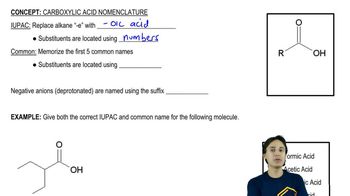
Carboxylic acids can be synthesized through various methods, including oxidation of alcohols. In this case, butan-2-ol can be oxidized to form a carboxylic acid. Understanding the reaction conditions and reagents required for oxidation is crucial for successful synthesis.
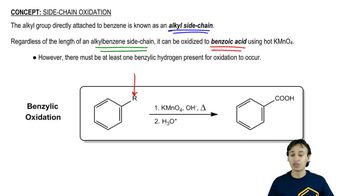
Oxidation reactions involve the loss of electrons or an increase in oxidation state, often resulting in the formation of carbonyl compounds or carboxylic acids from alcohols. For butan-2-ol, a common oxidizing agent like potassium dichromate or chromium trioxide can facilitate this transformation.
In organic synthesis, rearrangement and isomerization can lead to the formation of different structural isomers. The target compound, 2-methylbutanoic acid, suggests that the synthesis may involve a rearrangement of the carbon skeleton during the oxidation process, which is essential to achieve the desired product.