Ch. 8 - Delocalized Electrons: Their Effect on Stability, pKa, and the Products of a Reaction • Aromaticity and Electronic Effects: An Introduction to the Reactions of Benzene
Bruice - Organic Chemistry 8th Edition
Bruice8th EditionOrganic ChemistryISBN: 9780135213711Not the one you use?Change textbook
Chapter 9, Problem 54a

In what direction is the dipole moment in fulvene? Explain.

Verified step by step guidance
1
Step 1: Analyze the structure of fulvene. Fulvene consists of a five-membered ring with alternating double bonds (a conjugated system) and a methylene group (CH₂) attached via a double bond.
Step 2: Consider the electronegativity of the atoms involved. Carbon and hydrogen have different electronegativities, with carbon being more electronegative than hydrogen. Additionally, the conjugated ring system has delocalized π-electrons, which contribute to electron density distribution.
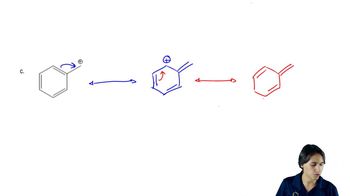
Step 3: Evaluate the electron density in the molecule. The conjugated ring system has a partial negative charge due to the delocalized π-electrons, while the methylene group (CH₂) attached to the ring has a partial positive charge because the π-electrons are pulled toward the ring.
Step 4: Determine the direction of the dipole moment. The dipole moment points from the region of lower electron density (partial positive charge) to the region of higher electron density (partial negative charge). In fulvene, the dipole moment points from the CH₂ group toward the conjugated ring system.
Step 5: Summarize the explanation. The dipole moment in fulvene is directed from the methylene group (CH₂) to the conjugated ring system due to the electron density being higher in the ring system compared to the CH₂ group.

Verified video answer for a similar problem:

This video solution was recommended by our tutors as helpful for the problem above.
Video duration:
6m
Was this helpful?

Key Concepts

Here are the essential concepts you must grasp in order to answer the question correctly.

Dipole Moment

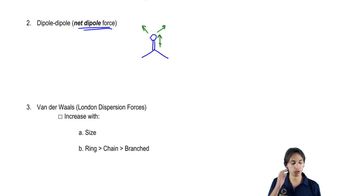
The dipole moment is a vector quantity that represents the separation of positive and negative charges in a molecule. It indicates the direction of the charge distribution and is influenced by the electronegativity of the atoms involved. A molecule with a dipole moment has a positive end and a negative end, which can affect its interactions with other molecules.
Recommended video:
Guided course
01:46
How dipole-dipole forces work.

Fulvene Structure

Fulvene is a cyclic compound characterized by a five-membered ring containing a double bond. Its structure includes a conjugated system of alternating single and double bonds, which can influence the distribution of electron density. Understanding the arrangement of atoms and bonds in fulvene is crucial for determining the direction of its dipole moment.
Recommended video:
Guided course
03:04
Drawing Resonance Structures

Electronegativity

Electronegativity is a measure of an atom's ability to attract and hold onto electrons within a chemical bond. In fulvene, the differences in electronegativity between the carbon atoms and any substituents can create regions of partial positive and negative charges, thereby influencing the overall dipole moment. Recognizing these differences is essential for predicting the dipole direction.
Recommended video:
Guided course
1:47
Electronegativity