Ch. 8 - Delocalized Electrons: Their Effect on Stability, pKa, and the Products of a Reaction • Aromaticity and Electronic Effects: An Introduction to the Reactions of Benzene
Bruice - Organic Chemistry 8th Edition
Bruice8th EditionOrganic ChemistryISBN: 9780135213711Not the one you use?Change textbook
Chapter 9, Problem 55a

Following the instructions for drawing the energy levels of the molecular orbitals for the compounds shown in [Figure 8.17], draw the energy levels of the molecular orbitals for the cycloheptatrienyl cation. For each compound, show the distribution of the π\(\pi\) electrons. Which of the compounds are aromatic?

Verified step by step guidance
1
Step 1: Recall the criteria for aromaticity. A compound is aromatic if it satisfies Hückel's rule, which states that a planar, cyclic molecule with conjugated π-electrons is aromatic if it has (4n + 2) π-electrons, where n is a non-negative integer.
Step 2: Analyze the structure of the cycloheptatrienyl anion. The cycloheptatrienyl anion is a seven-membered ring with alternating double bonds (a conjugated π-system) and an extra lone pair of electrons on the negatively charged carbon. This lone pair contributes to the π-electron count.
Step 3: Count the total number of π-electrons in the cycloheptatrienyl anion. Each double bond contributes 2 π-electrons, and the lone pair on the negatively charged carbon contributes 2 more π-electrons. Use MathML to represent the total π-electron count: 6 + 2 = 8.
Step 4: Draw the molecular orbital diagram for the cycloheptatrienyl anion. Arrange the energy levels of the molecular orbitals based on the cyclic π-system. The lowest energy orbital (bonding) will be fully filled, followed by higher energy orbitals. Distribute the 8 π-electrons into these orbitals, filling them according to the Aufbau principle (from lowest to highest energy).
Step 5: Determine if the compound is aromatic. Since the cycloheptatrienyl anion has 8 π-electrons, it does not satisfy Hückel's rule (4n + 2 = 8 is not possible for any integer n). Therefore, the cycloheptatrienyl anion is not aromatic.

Verified video answer for a similar problem:

This video solution was recommended by our tutors as helpful for the problem above.
Video duration:
7m
Was this helpful?

Key Concepts

Here are the essential concepts you must grasp in order to answer the question correctly.

Molecular Orbitals (MOs)

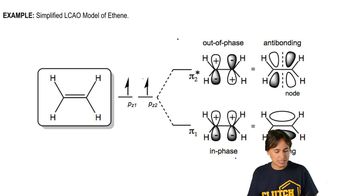
Molecular orbitals are formed by the linear combination of atomic orbitals (LCAO) and describe the behavior of electrons in a molecule. In the context of cycloheptatrienyl anion, understanding how these orbitals are filled with electrons is crucial for determining the stability and reactivity of the compound. The arrangement of these MOs can indicate the presence of bonding, antibonding, and non-bonding interactions.
Recommended video:
Guided course
08:41
Review of Molecular Orbitals

Aromaticity

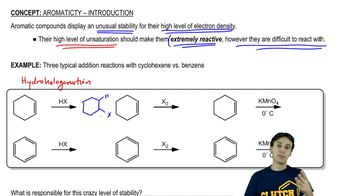
Aromaticity is a property of cyclic compounds that exhibit enhanced stability due to the delocalization of π electrons across the ring structure. For a compound to be considered aromatic, it must follow Hückel's rule, which states that it should have (4n + 2) π electrons, where n is a non-negative integer. Identifying whether the cycloheptatrienyl anion is aromatic involves analyzing its electron count and structure.
Recommended video:
Guided course
08:19
Intro to Aromaticity

Electron Distribution

Electron distribution refers to how electrons are arranged in molecular orbitals and how they contribute to the overall stability of a molecule. In the case of the cycloheptatrienyl anion, understanding the distribution of p electrons in the molecular orbitals is essential for determining its reactivity and whether it meets the criteria for aromaticity. This distribution can be visualized through energy level diagrams that illustrate the filling of MOs.
Recommended video:
Guided course
03:54
The 18 and 16 Electron Rule