Draw the structure of the predominant form of (e) a mixture of alanine, lysine, and aspartic acid at (i) pH 6;
Verified step by step guidance
1
Step 1: Understand the problem. You are tasked with determining the predominant form of alanine, lysine, and aspartic acid at pH 6. This involves analyzing the ionization states of their functional groups (amino, carboxyl, and side chains) based on their pKa values.
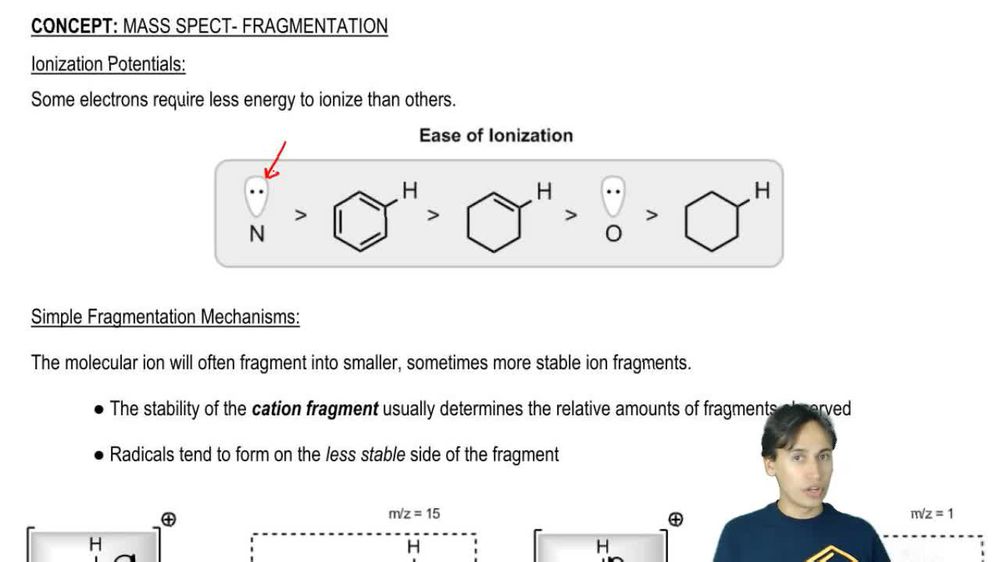
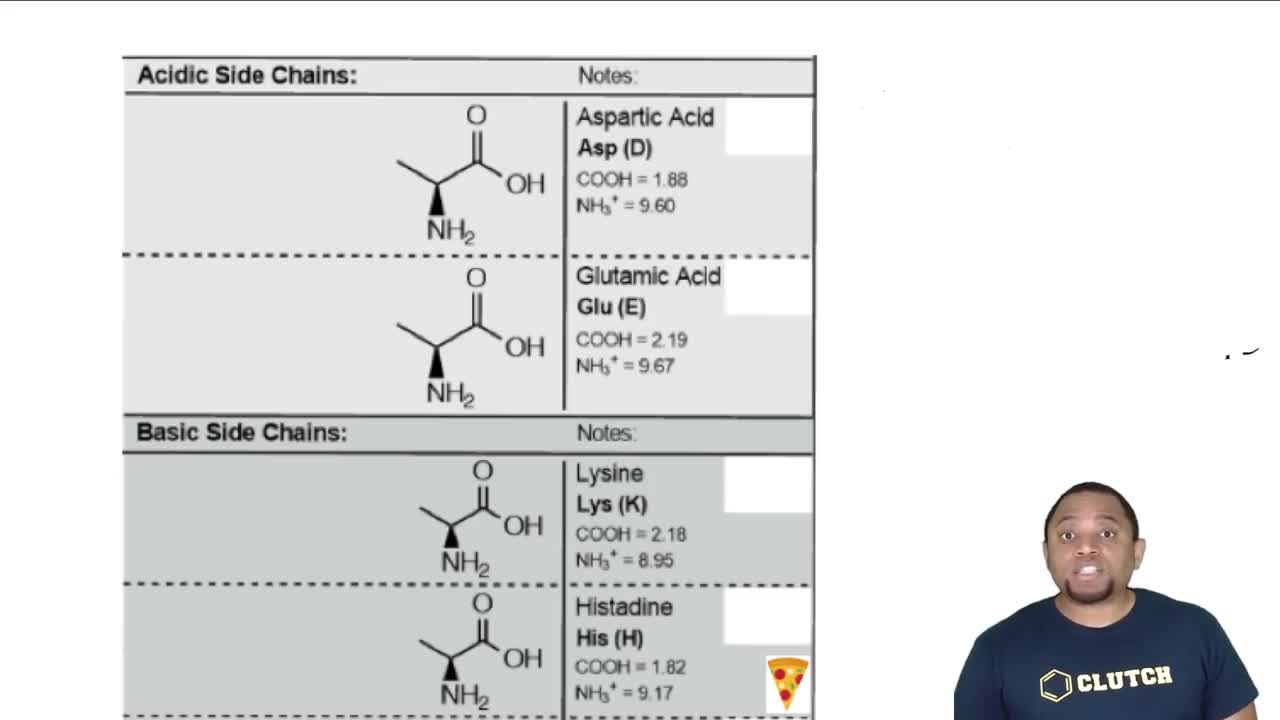
Step 2: Recall the pKa values of the relevant functional groups. For alanine, the amino group has a pKa of approximately 9.7, and the carboxyl group has a pKa of approximately 2.3. For lysine, the amino group has a pKa of approximately 9.0, the carboxyl group has a pKa of approximately 2.2, and the side chain amino group has a pKa of approximately 10.5. For aspartic acid, the amino group has a pKa of approximately 9.8, the carboxyl group has a pKa of approximately 2.1, and the side chain carboxyl group has a pKa of approximately 3.9.
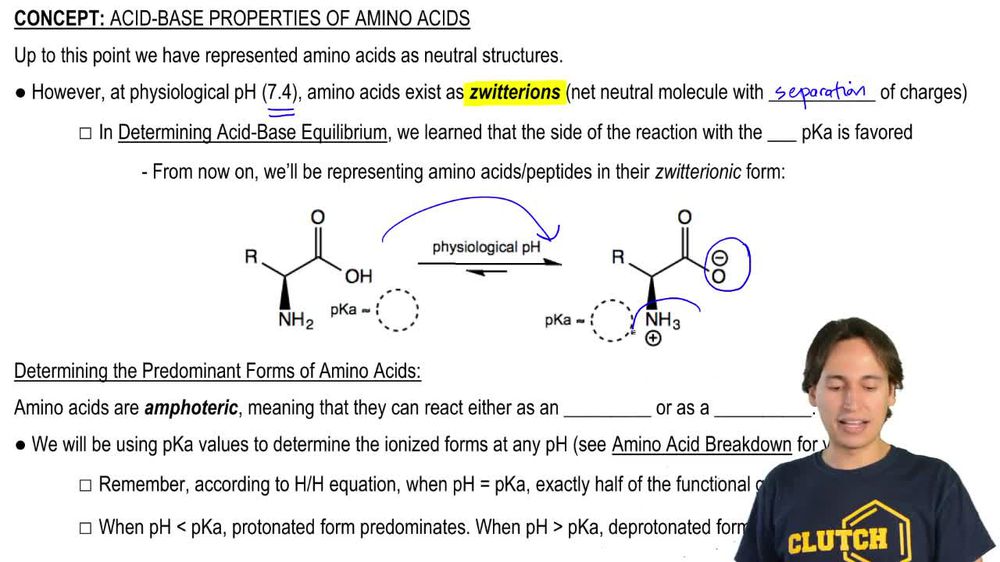
Step 3: Determine the ionization state of each functional group at pH 6. At this pH, groups with pKa values below 6 will be deprotonated (negative charge for carboxyl groups), and groups with pKa values above 6 will remain protonated (positive charge for amino groups). For alanine, the amino group will be protonated (+1), and the carboxyl group will be deprotonated (-1). For lysine, the amino group will be protonated (+1), the carboxyl group will be deprotonated (-1), and the side chain amino group will remain protonated (+1). For aspartic acid, the amino group will be protonated (+1), the carboxyl group will be deprotonated (-1), and the side chain carboxyl group will be deprotonated (-1).
Step 4: Combine the charges to determine the net charge of each amino acid at pH 6. Alanine will have a net charge of 0 (+1 from the amino group and -1 from the carboxyl group). Lysine will have a net charge of +1 (+1 from the amino group, -1 from the carboxyl group, and +1 from the side chain amino group). Aspartic acid will have a net charge of -1 (+1 from the amino group, -1 from the carboxyl group, and -1 from the side chain carboxyl group).
Step 5: Draw the structures of alanine, lysine, and aspartic acid at pH 6, showing the ionization states of their functional groups. Ensure that the amino groups are protonated where appropriate, the carboxyl groups are deprotonated, and the side chains reflect their correct ionization states. Label each structure clearly to indicate the amino acid and its net charge.
Verified video answer for a similar problem:
This video solution was recommended by our tutors as helpful for the problem above
Video duration:
7m
Play a video:
0 Comments
Key Concepts
Here are the essential concepts you must grasp in order to answer the question correctly.
Amino Acid Structure
Amino acids are organic compounds that serve as the building blocks of proteins. Each amino acid has a central carbon atom bonded to an amino group (-NH2), a carboxyl group (-COOH), a hydrogen atom, and a variable side chain (R group) that determines its unique properties. Understanding the structure of amino acids is essential for predicting their behavior in different pH environments.
pH is a measure of the acidity or basicity of a solution, influencing the ionization state of amino acids. At a specific pH, amino acids can exist in different forms: cationic, zwitterionic, or anionic. At pH 6, which is near the physiological pH, amino acids like alanine, lysine, and aspartic acid will have distinct charges that affect their overall structure and interactions.
A zwitterion is a molecule that has both positive and negative charges but is overall neutral. At physiological pH, amino acids typically exist as zwitterions, where the amino group is protonated (-NH3+) and the carboxyl group is deprotonated (-COO-). This form is crucial for understanding the solubility and reactivity of amino acids in biological systems.