The pH–activity profile for glucose-6-phosphate isomerase indicates the participation of a group with a pKa = 6.7 as a basic catalyst and a group with a pKa = 9.3 as an acid catalyst. Draw the pH–activity profile and identify the amino acids that participate in the catalysis.
Verified step by step guidance
1
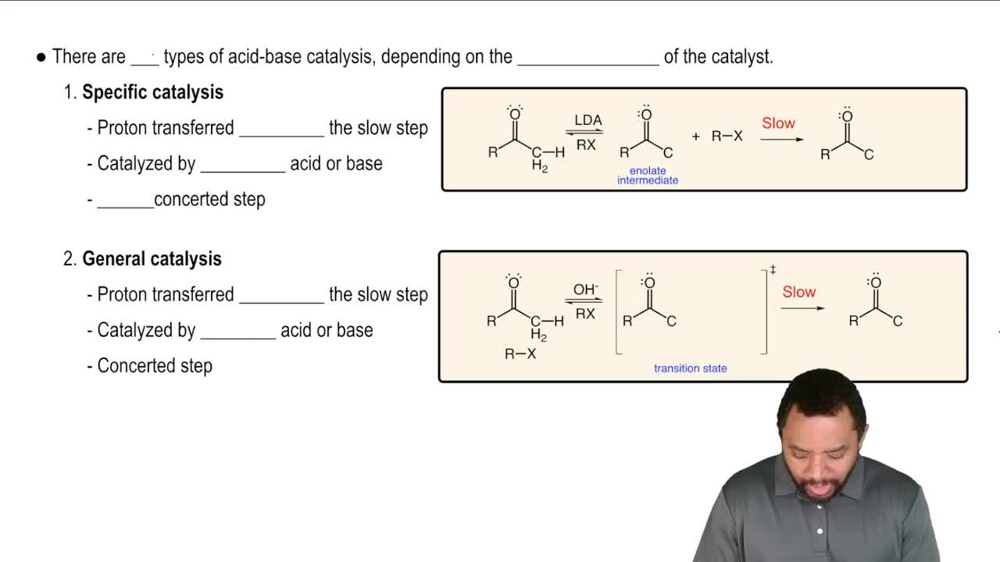
Understand the pH–activity profile: The pH–activity profile represents the enzyme activity as a function of pH. It helps identify the pKa values of functional groups involved in catalysis. Here, the enzyme has two key groups with pKa values of 6.7 and 9.3, indicating their roles as a basic and acidic catalyst, respectively.
Interpret the pKa values: A pKa of 6.7 suggests a group that acts as a base at pH values above 6.7, while a pKa of 9.3 suggests a group that acts as an acid at pH values below 9.3. These values correspond to the ionization states of amino acid side chains in the active site of the enzyme.
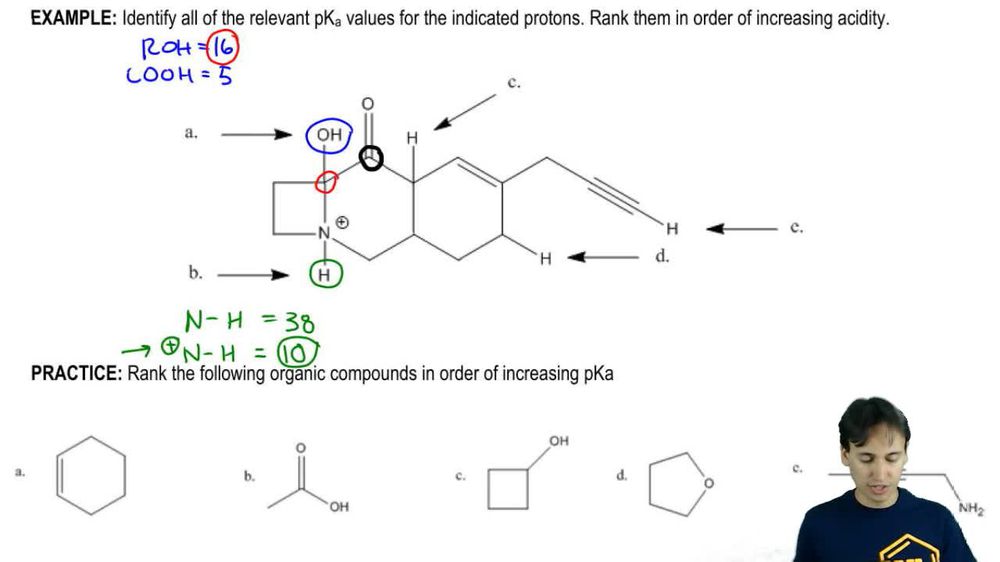
Identify potential amino acids: Amino acids with side chains that match these pKa values are likely involved in catalysis. For pKa = 6.7, histidine (imidazole group) is a strong candidate due to its pKa being close to this value. For pKa = 9.3, lysine (ε-amino group) or tyrosine (phenol group) could be involved, as their pKa values are in this range.
Draw the pH–activity profile: The profile will show enzyme activity peaking at a pH range where both groups are optimally ionized for catalysis. At pH values below 6.7, the basic group is protonated and inactive. At pH values above 9.3, the acidic group is deprotonated and inactive. Between these pH values, the enzyme exhibits maximum activity.
Summarize the catalytic mechanism: The basic group (likely histidine) facilitates proton abstraction, while the acidic group (likely lysine or tyrosine) donates a proton during the reaction. These groups work together to stabilize the transition state and drive the isomerization of glucose-6-phosphate.
Verified video answer for a similar problem:
This video solution was recommended by our tutors as helpful for the problem above
Play a video:
0 Comments
Key Concepts
Here are the essential concepts you must grasp in order to answer the question correctly.
pH-Activity Profile
The pH-activity profile illustrates how the activity of an enzyme varies with changes in pH. It typically shows peaks at optimal pH levels where the enzyme is most active, and declines at extreme pH values. Understanding this profile is crucial for identifying the ionization states of amino acid side chains that influence enzyme activity.
pKa is the measure of the strength of an acid in solution, indicating the pH at which half of the species are deprotonated. In enzymatic reactions, amino acids with side chains that have pKa values near the physiological pH can act as proton donors or acceptors, thus playing critical roles in catalysis. The pKa values provided (6.7 and 9.3) suggest specific amino acids are involved in acid-base catalysis.
Certain amino acids in enzymes can act as acid or base catalysts during biochemical reactions. For instance, histidine often participates in catalysis due to its imidazole side chain, which can be protonated or deprotonated depending on the pH. Identifying these amino acids in the context of the given pKa values is essential for understanding the mechanism of glucose-6-phosphate isomerase.

 Verified step by step guidance
 4:47
4:47